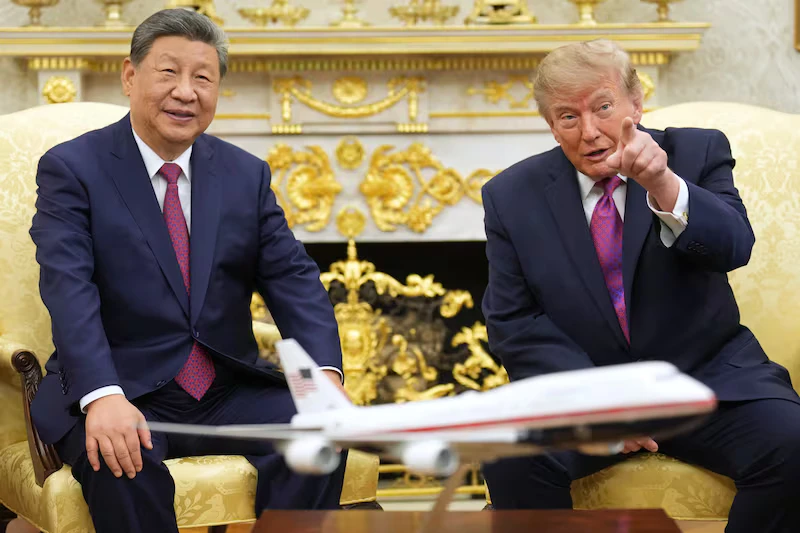
The official meeting between Chinese President Xi Jinping and US President Donald Trump took place on the 24th at a special state ceremony held at the White House in the United States. During this meeting, which marked the Chinese President's first state visit to the US in over a decade, China announced that it would provide a pair of giant pandas to Zoo Atlanta in Georgia, USA, and invite 100,000 American youths to China for study and cultural exchange programs within the next five years.
Although President Trump personally welcomed the Chinese leader at Joint Base Andrews Airport and appreciated the friendship between the two countries, behind this friendly symbolic meeting held in front of cameras, many sharp and complex geopolitical topics such as Artificial Intelligence (AI), trade tariffs, critical raw materials, the Taiwan crisis, and the Iran war were on the discussion table. Xi Jinping stated, "The hope for China-US relations lies with the people, and its future rests in the hands of the younger generation," emphasizing that China's "Great Rejuvenation" and America's "Make America Great Again" aspirations can go hand in hand. The new pair of pandas destined for Zoo Atlanta were born in 2020 at China's Chengdu Giant Panda Breeding Research Base.
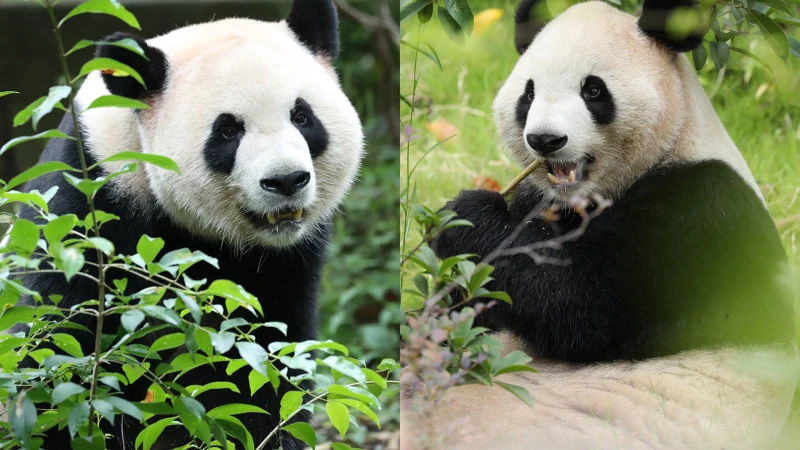
The six-year-old male panda named 'Ping Ping', affectionately known as 'Re Gan Mian' (a famous type of noodles from Wuhan) in China, which means 'peace', is known for being a voracious crop eater who follows zoo keepers.
The nearly six-year-old female panda named 'Fu Shuang', meaning 'double blessing', is identified as playful yet somewhat shy, resting her chin on a paw, and easily finding hidden apple pieces. It is noteworthy that Fu Shuang's paternal ancestors were wild pandas, a fact that helps preserve genetic diversity. According to a 10-year conservation agreement announced on April 23, 2026, between the Chinese Wildlife Conservation Association (CWCA) and Zoo Atlanta, this pair of pandas is expected to arrive in Atlanta within a few days. Under the global panda exchange program,
China retains full legal ownership of all pandas leased to foreign zoos, as well as their cubs born abroad, and they are returned to China after the contract period ends. Zoo Atlanta bred pandas for 25 years, from 1999 to October 12, 2024, during which seven cubs were born, including two sets of twins, from the original panda pair Lun Lun and Yang Yang. This was the most successful breeding record at an American zoo. After the last four pandas, Lun Lun, Yang Yang, Ya Lun, and Xi Lun, were returned to China in October 2024 on a special 'FedEx Panda Express' Boeing 777 aircraft, the panda complex in Atlanta remained empty. Preparations have been made to expand the zoo premises from February 2025 to welcome the incoming pair of pandas under the new agreement. Raymond B. King, CEO of Zoo Atlanta, stated that it is a great honor to once again earn trust as custodians of this valuable species.
With the arrival of Ping Ping and Fu Shuang, the total number of pandas in three US zoos will increase to six. Previously, in June 2024, China provided 'Yun Chuan' and 'Xin Bao' to the San Diego Zoo, and in October 2024, 'Bao Li' and 'Qing Bao' to the Smithsonian National Zoo in Washington, all under 10-year agreements. According to Chinese state media reports, all 17 cubs born from pandas given to America so far (6 in San Diego, 4 in Washington, and 7 in Atlanta) have been returned to China. This panda diplomacy, which began with the gifting of pandas to the Soviet Union in 1957, became more prominent after US President Richard Nixon's visit in 1972, when Ling-Ling and Hsing-Hsing were given to Washington. In the 1980s and 90s, this evolved into a fee-based leasing system, and
During the 2019-2024 period, when relations between the US and China deteriorated, panda agreements were not renewed. Similarly, with the deterioration of relations with Japan, the last pandas in Japan were recalled to China in January 2026. Representing the other side of diplomatic aspirations, Xi Jinping announced that 100,000 American youths would be invited to China for study and exchange programs within the next five years (2026-2031). This doubles the "50,000 in five years" program announced in San Francisco in November 2023, and China states that the original target was completed by May 2026.
These invitations include full degree programs as well as short-term visits, language camps, and study exchanges. However, there is a significant imbalance in educational exchange between the two countries; while approximately 265,919 Chinese students studied in the US during the 2024-25 academic year (a drop from the peak of 372,532 in 2019-20), the number of American students in China by 2026 remains below 2,000. Despite President Trump's preference for more Chinese students to stay in the US, considering the tuition fees received by American universities, prominent figures like Secretary of State Marco Rubio hold a strong stance on revoking Chinese student visas. Regarding China's invitation for 100,000 students, political commentators and Republican lawmakers suggest that short-term programs could be a tool for the Chinese state to spread political influence.
However, scholars like former US Ambassador Nicholas Burns point out that such relationships are important to prevent a shortage of American experts with an understanding of China. As Wu Xinbo of Fudan University noted, "Americans may not like China, but they certainly like pandas." Accordingly, China symbolically provides pandas, which it owns, to gain media attention, and uses this diplomatic step to present a softer side of its relations to the world amidst complex trade and security issues.