![Gossip Lanka News [English]](https://blogger.googleusercontent.com/img/a/AVvXsEhYm2aFFq-bIW1nWX-RrqnPFoIsVos6_VCVz8BpLt0QJi55GNXHXC2fugeRvL0qUStEuCfs7Sfu6ZiSlhrkldxfGuE_wzy5gitY6rMZ2KSi8VBbGvkgXLks37RwZV-4-HKbWiNLRxB8C_r1e4z3mpxFTMPDJPEADoG8E-bZteWFipeD5KNGbjvCfqEfKw=s300 "Gossip Lanka News [English]")
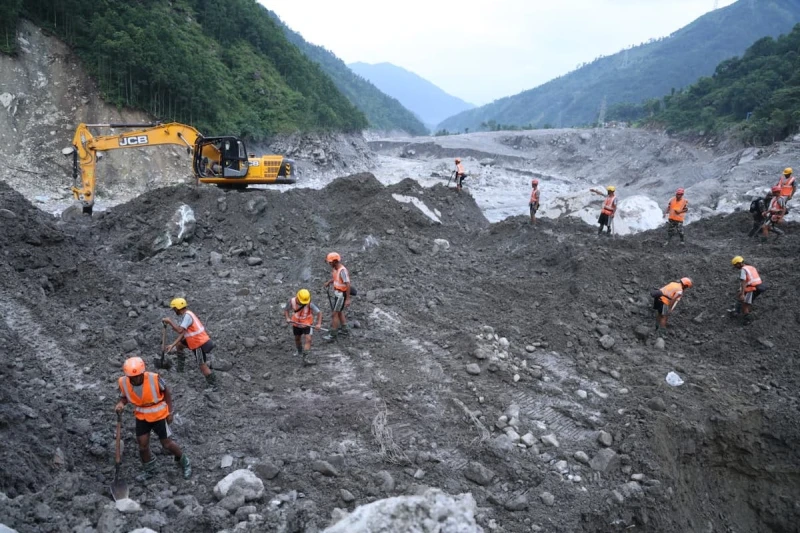
Although seven days have passed since operations began to find workers trapped in tunnels of hydropower projects due to massive floods that occurred in the vicinity of Nepal's Bhotekoshi and Trishuli rivers, the hope of them being alive has not yet been abandoned. Due to the mud, rocks, and landslides that came with the flood, the entrance portals of the tunnels are completely blocked, severely hindering rescue teams from entering inside.
However, these hopes remain alive as there are international examples of people trapped in large tunnels being rescued alive after nearly two weeks.The main reason for this is that the oxygen inside a tunnel does not immediately run out just because its entrance portal is closed. Theoretically, a tunnel section 500 meters long, 5 meters wide, and 5 meters high can hold approximately 12,500 cubic meters of air. The use of pipes and fan systems to maintain ventilation in tunnels under construction, and the reduced oxygen consumption when people remain calm instead of panicking, allow those trapped in existing 'air pockets' to breathe for a considerable period.
Although it is possible to survive for several days without food by using the energy stored in the body, the lack of clean drinking water is a deadly threat in such a situation. Even if there is water in the tunnels, its contamination with mud and dangerous microorganisms increases the risk. Furthermore, if the mud and large rocks that came with the flood have flowed deep into the tunnel, the chances of survival decrease due to reduced safe space for trapped individuals and the onset of conditions like hypothermia.
There are many precedents worldwide where individuals trapped in similar mine and tunnel accidents have survived for several days. In 2010, 115 workers trapped in China's Wangjialing coal mine were rescued after 8 days, and in 2022, two miners trapped for 9 days in South Korea were rescued alive. Furthermore, in the 1963 Lengede mine accident in Germany and the 2021 Hushan gold mine accident in China, workers were rescued after 14 days, and in the 2023 Silkyara tunnel accident in Uttarakhand, India, workers were rescued after 17 days, which gives reason for these hopes.
The main problem in the Bhotekoshi and Trishuli regions is that the topography has completely changed due to the floods. Due to massive rockfalls and landslides, even engineering plans have had to be used to locate the tunnel entrance portals. Nearly 900 workers from 11 hydropower projects in Nuwakot and Rasuwa districts have gone missing due to this disaster, and it is believed that at least 325 of them are trapped inside the tunnels. Specifically, about 300 people are trapped in the Upper Trishuli-1 project alone, and people are also trapped in the tunnels of Upper Trishuli-3 'A', Langtang Khola, and Chilime projects.
Criticisms have also been leveled regarding the slow progress of the operations. Kulman Ghising, former Executive Director of the Nepal Electricity Authority, and the Independent Power Producers' Association, Nepal (IPPAN) have raised accusations regarding the delay in calling foreign expert teams and conducting operations without proper coordination with project engineers and technical workers. The Nepali Army and other expert teams, including a 44-member disaster relief team from Korea, are currently making strenuous efforts to reach the trapped individuals by removing rocks and pumping out water and air.