![Gossip Lanka News [English]](https://blogger.googleusercontent.com/img/a/AVvXsEhYm2aFFq-bIW1nWX-RrqnPFoIsVos6_VCVz8BpLt0QJi55GNXHXC2fugeRvL0qUStEuCfs7Sfu6ZiSlhrkldxfGuE_wzy5gitY6rMZ2KSi8VBbGvkgXLks37RwZV-4-HKbWiNLRxB8C_r1e4z3mpxFTMPDJPEADoG8E-bZteWFipeD5KNGbjvCfqEfKw=s300 "Gossip Lanka News [English]")
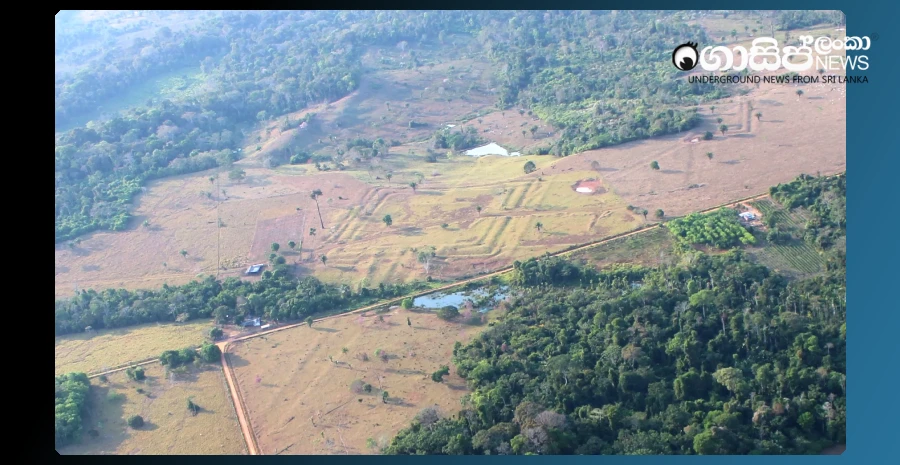
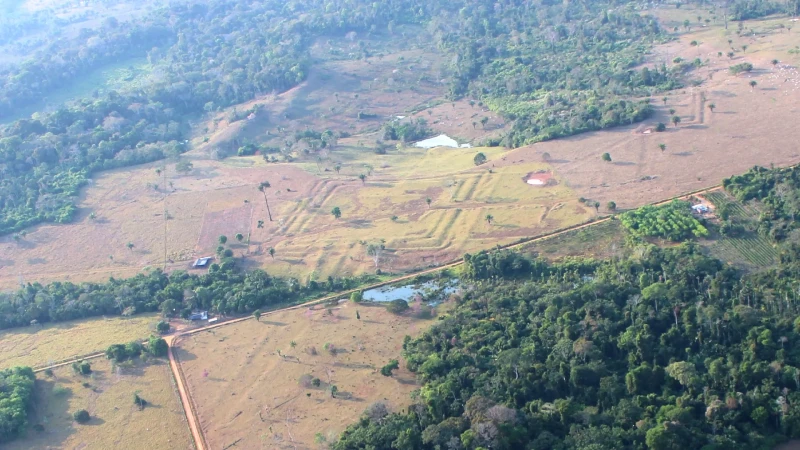
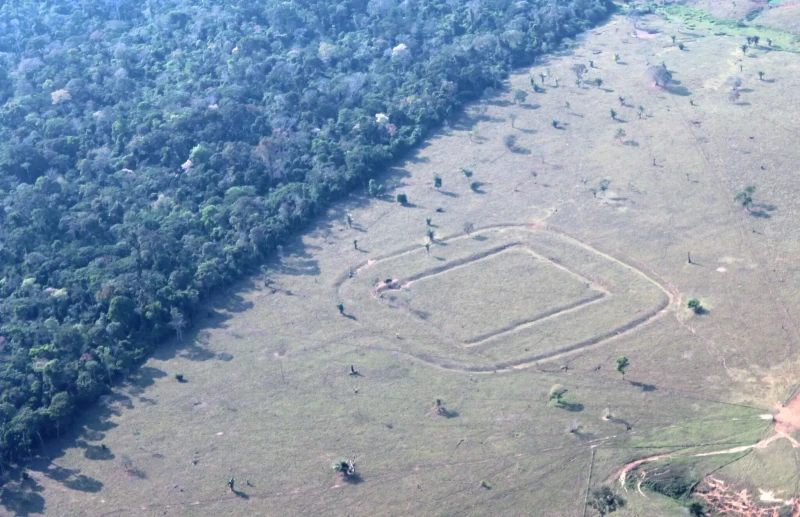
Archaeologists have discovered hundreds of ancient, massive geometric shapes in the southwestern Amazon region, hinting at complex societies that lived in the Amazon rainforest approximately a millennium before the arrival of Spanish and Portuguese colonialists. This significant discovery, made near the borders of Bolivia, Brazil, and Peru, has completely overturned the long-held belief that the Amazon rainforest remained untouched by human presence before the arrival of Europeans.
According to this research report published in 'Nature' magazine, these creations hidden beneath the dense forest canopy are known as geoglyphs, and nearly four hundred previously unknown earthwork and ditch structures of this kind have been newly discovered there.To observe these hidden structures, invisible to the naked eye, researchers used a specialized laser scanning technology called lidar. These geometric designs, believed to date between 600 BC and 850 AD, include circles, squares, and interconnected roads. Many of the designs span an area of about seven acres and contain large ditches approximately 30 feet wide and 15 feet deep. Furthermore, it has been experimentally confirmed that the largest shape found here extends over an area of more than 120 acres.
Dr. Martti Pärssinen, Professor Emeritus at the University of Helsinki and lead author of this research, states that these structures belong to an ancient multicultural and multilingual society called 'Aquiry'. Based on oral information from the Apurina indigenous group, researchers believe that these geometric shapes may have been used for festivals, political events, religious activities, dances, music, and ball games. However, within this massive region spanning 1,700 square miles, archaeologists have not yet found any evidence of permanent settlements belonging to the Aquiry era, which ended around 900 AD.
Dr. Pärssinen's research team estimates that the total population in this region may have grown to three million during the golden age of the Aquiry society. These new discoveries strongly confirm that historical accounts of densely populated settlements described by missionaries like Gaspar de Carvajal, who traveled through the Amazon rainforest in the 1540s, were not mere fantasies. However, Eduardo Neves, an archaeologist from the University of São Paulo in Brazil, who is not part of the research team, points out that these valuable archaeological heritages are currently under severe threat due to modern deforestation for logging and soybean cultivation.