![Gossip Lanka News [English]](https://blogger.googleusercontent.com/img/a/AVvXsEhYm2aFFq-bIW1nWX-RrqnPFoIsVos6_VCVz8BpLt0QJi55GNXHXC2fugeRvL0qUStEuCfs7Sfu6ZiSlhrkldxfGuE_wzy5gitY6rMZ2KSi8VBbGvkgXLks37RwZV-4-HKbWiNLRxB8C_r1e4z3mpxFTMPDJPEADoG8E-bZteWFipeD5KNGbjvCfqEfKw=s300 "Gossip Lanka News [English]")
Researchers have succeeded in uncovering a wealth of important evidence regarding the settlements of ordinary people who lived in the past, during major archaeological excavations carried out in the vicinity of Sri Lanka's historic Yapahuwa Kingdom. This provides a rare opportunity to understand what life was like for people during a major historical era on the island.
Although archaeological discoveries in this country have predominantly revealed monastic complexes where Buddhist monks resided and royal palaces used by kings, there has been very little information about areas where ordinary people lived. These latest findings from Yapahuwa shed new light on that aspect of Sri Lankan history.
With the fall of the Polonnaruwa Kingdom due to Kalinga Magha's South Indian invasion, Yapahuwa emerged as the fourth kingdom in the country. Due to this aggressive situation, both rulers and ordinary people had to migrate to other parts of the island for their safety.
During that era, the primary criterion for establishing new capitals was security. Therefore, rulers were inclined to choose isolated mountains and naturally protected locations for constructing royal residences and safely enshrining the sacred Tooth Relic.
In such an environment, Yapahuwa was established as the fourth kingdom of the country. After the reign of King Vijayabahu IV, King Bhuvanekabahu I, who ascended the throne in the 13th century, made Yapahuwa his royal capital.
Although the Yapahuwa Kingdom existed for only a short period of about 12 years, it transformed into one of the most secure and artistically valuable capitals in the country's history. The kingdom's security was provided by inner and outer walls, as well as a double moat system.
The world-renowned rock staircase and lion figures of Yapahuwa are still considered today as supreme examples showcasing the unparalleled skill of ancient Sri Lankan architecture and carving art.
With the aim of uncovering the hitherto undiscovered secrets of this kingdom, the Central Cultural Fund launched a new archaeological excavation project in 2025 under the direction of Professor Mangala Katugampola.
Modern technology has also been widely used for these researches, with experts employing LiDAR technology and Ground Penetrating Radar (GPR) techniques to survey the site.
Researchers selected the area between Yapahuwa's inner and outer walls for horizontal excavations, where they were able to make one of the most unique discoveries found to date.
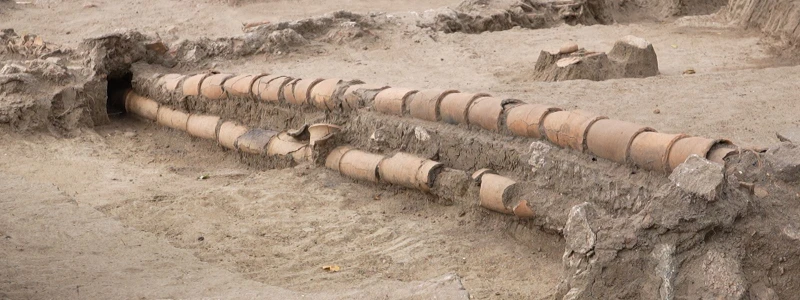
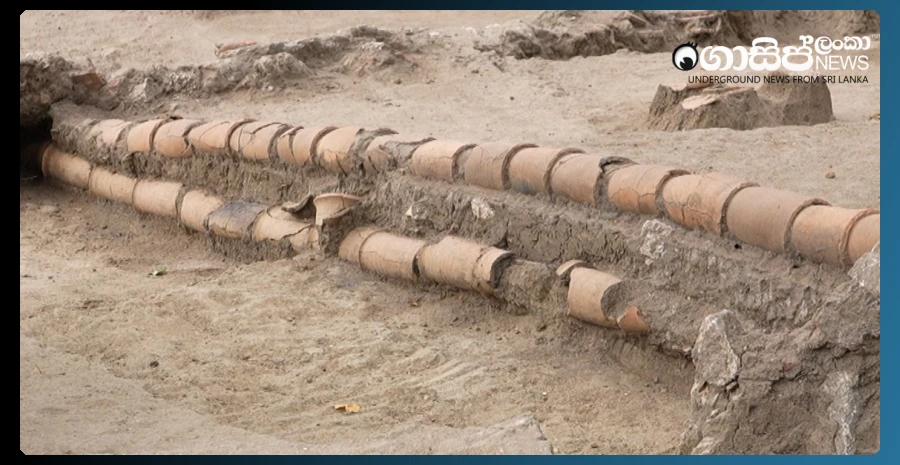
The excavation team succeeded in discovering a unique underground clay pipe system, unlike any found elsewhere in Sri Lanka. Archaeologists have found three distinct underground pipe systems running parallel to each other in the same direction within a single structure.
While previously found foreign coins from Yapahuwa confirmed international relations, researchers believe that these new discoveries can provide a deeper understanding of Sri Lanka's social and urban history.
In addition, a large number of artifacts, including clay lamps, pottery fragments, Chinese porcelain shards, metal nails, and many other clay creations, have been found at this excavation site.
Professor Katugampola states that these artifacts do not belong to monastic use, and therefore, they were likely used by the ordinary residents who lived in this ancient urban settlement.
These discoveries will lead to a substantial growth in the existing knowledge about Yapahuwa, revealing many hitherto unknown details about the lifestyle of ordinary people within a medieval kingdom.
By providing rare evidence of how ordinary people lived around a major royal capital in Sri Lanka, these discoveries will make a significant contribution to future studies on the country's urban history, social structure, and settlement patterns.