![Gossip Lanka News [English]](https://blogger.googleusercontent.com/img/a/AVvXsEhYm2aFFq-bIW1nWX-RrqnPFoIsVos6_VCVz8BpLt0QJi55GNXHXC2fugeRvL0qUStEuCfs7Sfu6ZiSlhrkldxfGuE_wzy5gitY6rMZ2KSi8VBbGvkgXLks37RwZV-4-HKbWiNLRxB8C_r1e4z3mpxFTMPDJPEADoG8E-bZteWFipeD5KNGbjvCfqEfKw=s300 "Gossip Lanka News [English]")
Several leading international media organizations worldwide have paid close attention to the recent severe riot and the significant loss of life that occurred at the Negombo Prison in Sri Lanka. Foreign news services report that this violent situation originated from a clash between two drug trafficking gangs within this old prison, built in 1914, which is severely overcrowded with prisoners, far exceeding its holding capacity.
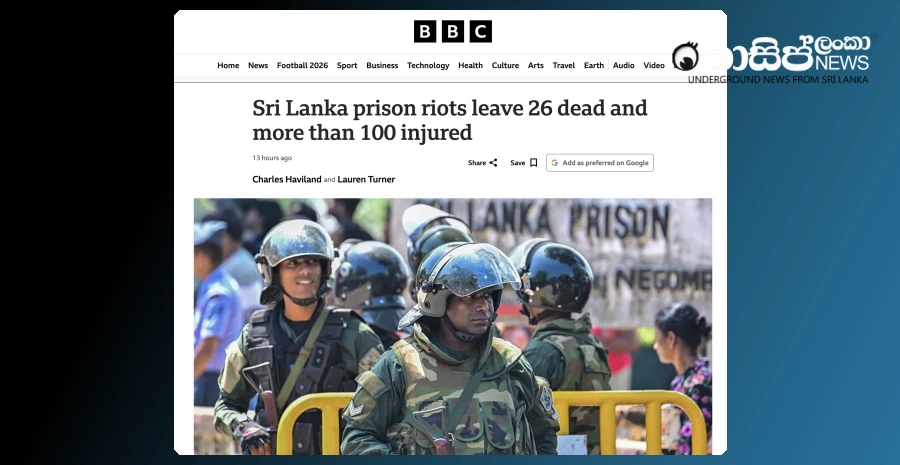
These media reports state that although security forces intervened and attempted to control the situation, approximately 26 people, including seven prison officers and guards, died, and over a hundred individuals were hospitalized with gunshot and cut wounds.The British Broadcasting Corporation (BBC) news service, reporting on the incident, stated that these two-day long violent acts clearly exposed the chronic overcrowding within Sri Lanka's prison system to the world. They described how the conflict, which began between groups involved in drug trafficking, later escalated into an attempt by a large number of people to escape from the prison hospital and a protest by female inmates on the prison roof. Citing officials, the BBC news service, which identified the severe national-level pressure within prisons as a major contributing factor to the incident, also reported that an official investigation and efforts to transfer prisoners to other locations have commenced.
Al Jazeera news service, in its reporting, dedicated more space to highlighting the humanitarian aspect of the incident and the critical situation faced by the relatives of the victims' families. Citing Ms. Pushpa Gamlath, Director of Negombo Hospital, they reported how injured inmates were transported to the hospital by police buses and how bodies were received. Journalists reporting directly from the scene pointed out that this marks one of the most severe prison riots in Sri Lanka's recent history, and it also included the deep distress of relatives gathered near the prison gate, demanding information and justice from the relevant authorities.
The New York Times, in its report, emphasized that the situation at Negombo Prison, located north of Colombo, was the most serious act of violence reported in several decades. The newspaper stated that the death toll from this dispute, which erupted between drug trafficking gangs and their rivals, could further increase, and about 15 individuals were in critical condition. The New York Times further pointed out that international criticisms regarding human rights issues, minimal space, and inhumane conditions within Sri Lankan prisons have once again come to the forefront with this tragedy.
Regional media outlets such as The Guardian in Britain, Dawn in Pakistan, and WION and NDTV in India also presented this tragedy and its severity to the world. Citing statistics on prison overcrowding, ranging from 200% to 400%, they stated that systemic weaknesses, such as holding over 41,000 individuals in a system designed for typically 11,000, initiate such situations. Recalling previous riots at Welikada in 2012 and Mahara prisons in 2020, all these foreign media organizations emphasized the importance of urgent systemic reforms and the immediate need to streamline the prisoner rehabilitation process.