![Gossip Lanka News [English]](https://blogger.googleusercontent.com/img/a/AVvXsEhYm2aFFq-bIW1nWX-RrqnPFoIsVos6_VCVz8BpLt0QJi55GNXHXC2fugeRvL0qUStEuCfs7Sfu6ZiSlhrkldxfGuE_wzy5gitY6rMZ2KSi8VBbGvkgXLks37RwZV-4-HKbWiNLRxB8C_r1e4z3mpxFTMPDJPEADoG8E-bZteWFipeD5KNGbjvCfqEfKw=s300 "Gossip Lanka News [English]")
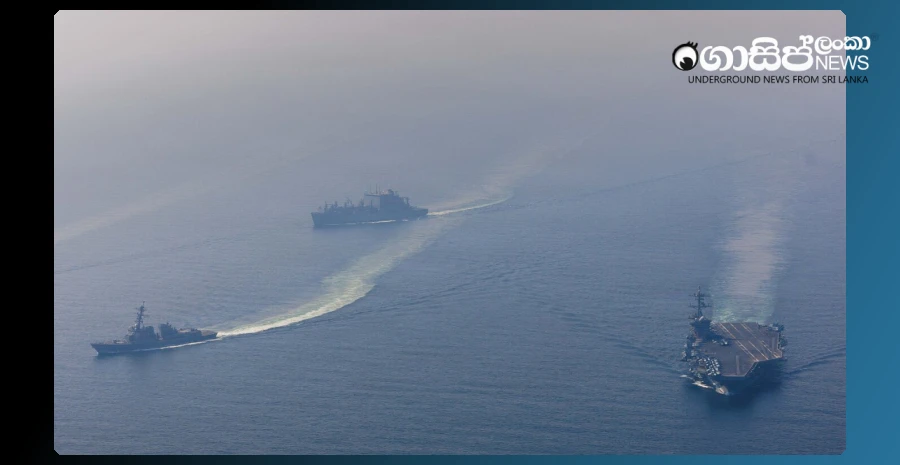
The military situation between the United States and Iran, centered around the Strait of Hormuz, has significantly escalated in the past 24 hours. The US Central Command has launched a massive series of precision strikes over a seven-hour period, targeting Iranian missile and drone launch sites, naval assets, and coastal defense systems near the Strait of Hormuz.
The US states that the purpose of these attacks is to ensure the security of this vital sea lane, through which approximately 20% of the world's oil supply is transported, and to suppress threats to commercial shipping. Currently, over 20 US Navy warships and hundreds of aircraft are actively operating in the region, and a naval blockade targeting vessels entering and exiting Iranian ports has been reimposed. However, critics say that this naval blockade could further plunge the Iranian economy into a severe crisis, potentially leading to a wider regional conflict and unexpected retaliatory attacks.
In response to US operations, Iran has launched a massive series of retaliatory attacks. Accordingly, ballistic missile attacks were launched against King Faisal Air Base in Jordan, and drone attacks were carried out against storage complexes at a US air base in Kuwait. These actions can be seen as a further step in the attacks on Jordan and Bahrain in recent days. US defense systems have managed to destroy most of the missiles and drones launched by Iran in the air, so no immediate casualties have been reported on the US side. Although Tehran stated that these steps were taken for self-defense against US aggression using its regional forces and proxy networks, such attacks have raised the risk of other Gulf countries like Kuwait and Jordan becoming directly involved in the conflict.
Meanwhile, US President Donald Trump officially informed Congress on July 14 that hostilities with Iran have resumed since July 7. This notification, following a brief ceasefire, activates a new 60-day period for military operations under the War Powers Resolution. In a special discussion at the White House, President Trump warned that if Iran does not come to the negotiating table and does not open the Strait of Hormuz, massive attacks will be launched in the coming days targeting infrastructure such as energy centers, power plants, and bridges in the country. While supporters point to this Trump administration tactic as a means to exert severe pressure on Iran, opposition leaders fear that the systematic destruction of civilian infrastructure will lead the Iranian people to face an immense humanitarian crisis.
Amidst the ongoing war, international attention has also been drawn to the harm caused to civilians. Specifically, US Democratic senators are demanding that the Pentagon release the investigation report on the incident in February 2026, where over 150 civilians, including more than 120 schoolchildren, were killed in a US attack on Shajare Taiyebbe Primary School in Minab, southeastern Iran. Reports indicate that this attack was based on outdated intelligence, and thousands of civilians have been killed or injured in operations from early 2026 to date. Although the Pentagon states that such damage occurs even with the use of precision weapons because Iran keeps its military assets in civilian areas, parties demanding transparency accuse this of violating international law and ethical responsibilities.
The impact of this US-Iran conflict is also spreading to other regional countries. Houthi rebels in Yemen, supported by Iran, have launched ballistic missile and drone attacks targeting Saudi Arabia, and Israeli Prime Minister Netanyahu has stated that he will not hesitate to attack any party that threatens them, anywhere. This statement directly targets Iran, and Israel has further affirmed its relations and coordination with US forces. Although countries like Saudi Arabia have tried to avoid direct involvement in this conflict, the entire Middle East region is on the brink of a large-scale war in the face of Houthi and Iranian threats.
This situation has also severely impacted the global economy and the energy sector. Although the Strait of Hormuz is not completely closed, fuel prices in the world market remain high due to existing military blockades and threats. Specifically, prices for diesel and jet fuel have risen sharply due to disruptions in refining and transportation. Forecast market data indicates that the probability of shipping traffic in the Strait of Hormuz returning to normal by the end of this year is only 50%. If the US further attacks Iran's energy sector, there is a risk of severe global economic inflation and supply disruptions.
The direct impact of this global energy crisis is also strongly felt in South Asian countries, including Sri Lanka. Although Sri Lanka had foreign exchange reserves this time compared to the economic crisis in 2022, physical obstacles in obtaining fuel from the Middle East have once again led to fuel queues in the country. Domestic fuel prices have increased by about 25%, and the government has had to reintroduce a four-day work week system to conserve fuel. Transport, agriculture, and small-scale businesses have been severely affected by this, and post-crisis economic recovery has been significantly hampered. This conflict between distant superpowers has succeeded in completely disrupting the daily economic processes of developing countries like Sri Lanka.