![Gossip Lanka News [English]](https://blogger.googleusercontent.com/img/a/AVvXsEhYm2aFFq-bIW1nWX-RrqnPFoIsVos6_VCVz8BpLt0QJi55GNXHXC2fugeRvL0qUStEuCfs7Sfu6ZiSlhrkldxfGuE_wzy5gitY6rMZ2KSi8VBbGvkgXLks37RwZV-4-HKbWiNLRxB8C_r1e4z3mpxFTMPDJPEADoG8E-bZteWFipeD5KNGbjvCfqEfKw=s300 "Gossip Lanka News [English]")
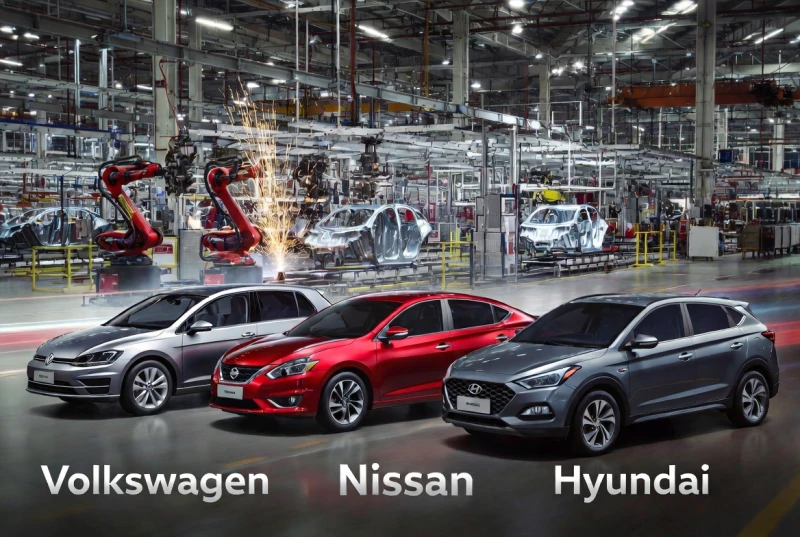
Foreign car manufacturers, who previously produced vehicles in China and sold them exclusively in the domestic market, are now taking steps to transform their joint venture factories into global export hubs. Leveraging China's efficient manufacturing ecosystem, cost advantages, and advanced local technology to enhance their competitiveness in the international market has become the primary strategy for these multinational companies.
Nissan of Japan, showing particular interest in this regard, plans to export the 'N7' sedan, produced by Dongfeng Nissan, to Latin America and Southeast Asia. Additionally, they are arranging to export the 'Frontier Pro' pickup truck to the Middle East and 'NX8' type SUVs. At a car show in Beijing, Nissan CEO Ivan Espinosa stated that due to technological advancements and low costs in China, their short-term goal is to export 100,000 vehicles, and their long-term goal is 300,000 vehicles.
Hyundai, South Korea's largest car manufacturer, has also begun to use China not merely as a production hub, but also as a center for research and development activities, as well as for introducing new products to other countries. Its CEO, Jose Muñoz, states that they intend to utilize the latest technology in China and export the vehicles produced there to other regions.
Germany's Volkswagen is also taking steps to use China as its export base. Through partnerships with Chinese domestic companies like XPeng and CATL, they have succeeded in reducing vehicle design and development time by 30% and costs by 40%. According to Volkswagen Group CEO Oliver Blume, they intend to supply vehicles and services from China to countries in the Southern Hemisphere. Under this initiative, the 'ID. ERA 9X' electric vehicle, produced with Chinese technology, is even slated for export to Germany.
Automotive analysts point out that China has become a global leader in electrification and intelligent driving technology, making the Chinese market essential for foreign companies. Due to intense competition in the Chinese domestic market, the market share of foreign joint ventures, which stood at 60-70% in 2014, fell to 30% by 2025. Consequently, the production capacity of many factories was underutilized, but this new export strategy has prevented those factories from closing down and provided an opportunity to reactivate them.
Among the companies that have successfully implemented this export process, Yueda Kia stands out, having exported over 582,000 vehicles from its factory in Jiangsu province since 2018. Beijing Hyundai also exported 82,000 vehicles in 2025, representing a 48.7% increase compared to the previous year. SAIC Volkswagen has also begun exporting its latest model vehicles to countries like Uzbekistan via the China-Europe railway.
While in the past, China primarily exported traditional fuel vehicles designed abroad and manufactured in China, the current trend is towards exporting New Energy Vehicles (NEVs) fully designed with Chinese technology and within China itself. Analysts predict that the contribution of NEVs to China's total vehicle exports will exceed 60% this year, up from 35% in 2025.