![Gossip Lanka News [English]](https://blogger.googleusercontent.com/img/a/AVvXsEhYm2aFFq-bIW1nWX-RrqnPFoIsVos6_VCVz8BpLt0QJi55GNXHXC2fugeRvL0qUStEuCfs7Sfu6ZiSlhrkldxfGuE_wzy5gitY6rMZ2KSi8VBbGvkgXLks37RwZV-4-HKbWiNLRxB8C_r1e4z3mpxFTMPDJPEADoG8E-bZteWFipeD5KNGbjvCfqEfKw=s300 "Gossip Lanka News [English]")
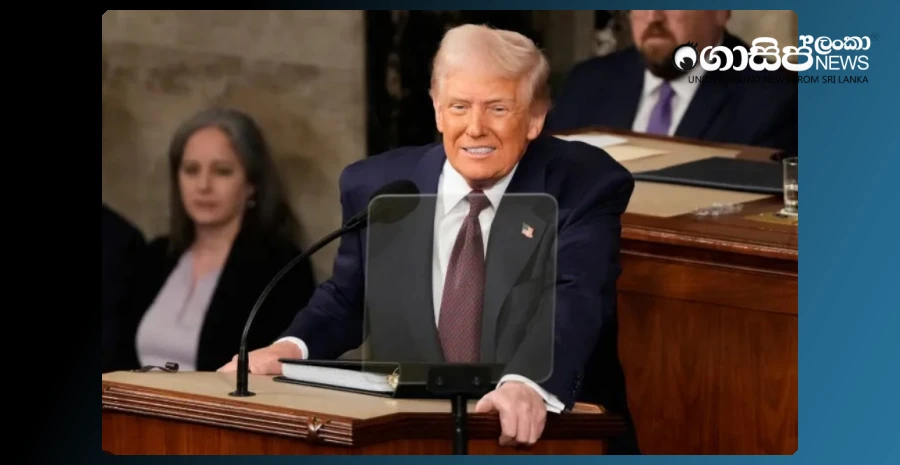
A fact-finding investigation in Washington reveals that President Trump has presented numerous false and exaggerated figures to downplay the economic impact of the ongoing conflict with Iran. He told reporters that he does not consider the financial difficulties faced by Americans when entering into negotiations, and that his sole objective is to prevent Iran from producing nuclear weapons.
However, White House spokesperson Kush Desai states that even if inflation rises, the government is focusing heavily on accelerating economic growth and minimizing costs. He also points out that energy prices and inflation will fall again once the Iranian nuclear threat subsides and maritime traffic in the Strait of Hormuz returns to normal.Trump has stated that the current inflation rate is much lower than during the Biden administration, and that the highest inflation in the country's history was recorded during Biden's tenure. He also claimed that inflation was as low as 1.7 percent in the three months preceding the war, but this statement has been revealed to be false. The highest inflation in the country's history has not been recorded; instead, inflation rose to 9 percent in June 2022, marking a four-decade high. When Trump took office, it had fallen to 3 percent, and in the three months before the war, inflation was not 1.7 percent but rather values like 2.7, 2.4, and 2.4 percent. After the war began, it further increased to 3.3 and 3.8 percent.
Trump posted on social media that during the Biden administration, the price of a barrel of crude oil was $120, and under the current administration, it has fallen by 25 percent to $90. Although Brent crude oil prices rose to $120 in June 2022 during Biden's term, it had fallen to $80 when Trump took office. The price further decreased in the first year of his term, but with the start of the Iran war, it rapidly began to rise again, reaching $101 per barrel by May 8, making his statement misleading.
Trump's claim that fuel prices have significantly fallen currently is also confirmed to be false according to government and independent data. According to AAA Motor Club data, gas prices had risen to $4.56 per gallon by May 7, which is a 53 percent increase from the price on February 28, when the war began. According to the Energy Information Administration, the average gas price for the week ending May 4 was reported as $4.45, which also shows a 52 percent increase compared to the pre-war price.
Trump has stated that America does not need the Strait of Hormuz and that it does not use the strait because it obtains oil by boat from states like Texas, Louisiana, and Alaska. This statement is also an exaggeration; while it is true that a very small amount of crude oil imported into America comes through the Strait of Hormuz, it is incorrect to say that America does not use this waterway at all. According to 2024 data, America imports approximately 500,000 barrels of crude oil per day through this strait, which accounts for 7 percent of total crude oil imports and 2 percent of consumption.
In addition to crude oil, America heavily relies on this strait for the import and export of other essential goods. Between 12 and 17 percent of materials widely used for fertilizers, 22 percent of aluminum imports, and 25 percent of helium imports are transported through this route. According to the Congressional Research Service, 20 percent of America's sauce and spice exports, 20 percent of passenger cars, and 15 percent of trucks pass through this region around the Persian Gulf, making its economic importance very high.