![Gossip Lanka News [English]](https://blogger.googleusercontent.com/img/a/AVvXsEhYm2aFFq-bIW1nWX-RrqnPFoIsVos6_VCVz8BpLt0QJi55GNXHXC2fugeRvL0qUStEuCfs7Sfu6ZiSlhrkldxfGuE_wzy5gitY6rMZ2KSi8VBbGvkgXLks37RwZV-4-HKbWiNLRxB8C_r1e4z3mpxFTMPDJPEADoG8E-bZteWFipeD5KNGbjvCfqEfKw=s300 "Gossip Lanka News [English]")
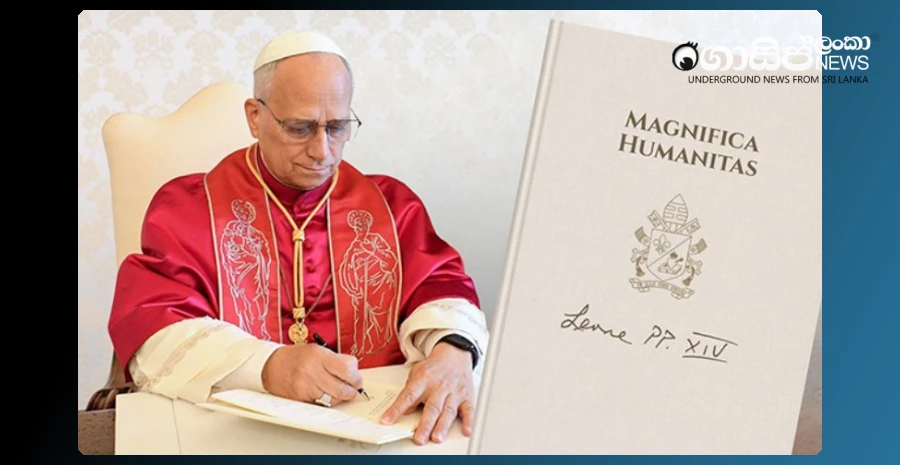
Pope Leo XIV, the current Pontiff, published his inaugural encyclical on Artificial Intelligence (AI) titled 'Magnifica Humanitas' (Magnificent Humanity) last Monday at the Vatican. Modeled after Pope Leo XIII's 'Rerum Novarum,' issued in 1891 to analyze the social impacts of the Industrial Revolution, this encyclical aims to find solutions to the challenges humanity faces amidst the current digital transformation.This document, comprising approximately 42,000 words, describes the challenges arising with the growth of artificial intelligence and strongly urges political leaders to take steps to protect human dignity, as technology is currently outpacing ethical regulations.
The primary focus of this document is to emphasize the unique value and status of human beings. The Pope highlights the importance of protecting humanity from a future tragedy where machines usurp the roles of a large segment of the population. This provides a fundamental basis for an ethical dialogue in fields ranging from care services to autonomous warfare. It states that if individuals merely become tools within an algorithmic system, human progress and freedom could be severely harmed.
These remarks have become even more timely with Donald Trump's decision last week to postpone an executive order that would have mandated a review of the safety of new artificial intelligence models. The report also indicates that in the midst of technological competition, the actions of profit-driven individuals like Elon Musk could pose a threat to the common good. Therefore, 'Magnifica Humanitas' further affirms the necessity of state regulation to ensure that the unique benefits derived from artificial intelligence are utilized for the well-being of all.
It is noteworthy that Christopher Olah, a co-founder of the 'Anthropic' company, who is an atheist, was present at the launch of this encyclical. 'Anthropic,' which faced strong criticism from Mr. Trump for refusing to support the use of its technology for military purposes and mass surveillance, now represents an ethical dimension in the field of artificial intelligence. Although some of the company's views on language models like 'Claude' contradict Catholic ideologies, the Vatican considers this collaboration a symbol of an essential ethical dialogue. Through his publication, the Pope has shown the world that each generation inherits the responsibility to shape its era, and history must be guided towards a future where the dignity of every individual is protected, justice is promoted, and fraternity is built.