![Gossip Lanka News [English]](https://blogger.googleusercontent.com/img/a/AVvXsEhYm2aFFq-bIW1nWX-RrqnPFoIsVos6_VCVz8BpLt0QJi55GNXHXC2fugeRvL0qUStEuCfs7Sfu6ZiSlhrkldxfGuE_wzy5gitY6rMZ2KSi8VBbGvkgXLks37RwZV-4-HKbWiNLRxB8C_r1e4z3mpxFTMPDJPEADoG8E-bZteWFipeD5KNGbjvCfqEfKw=s300 "Gossip Lanka News [English]")
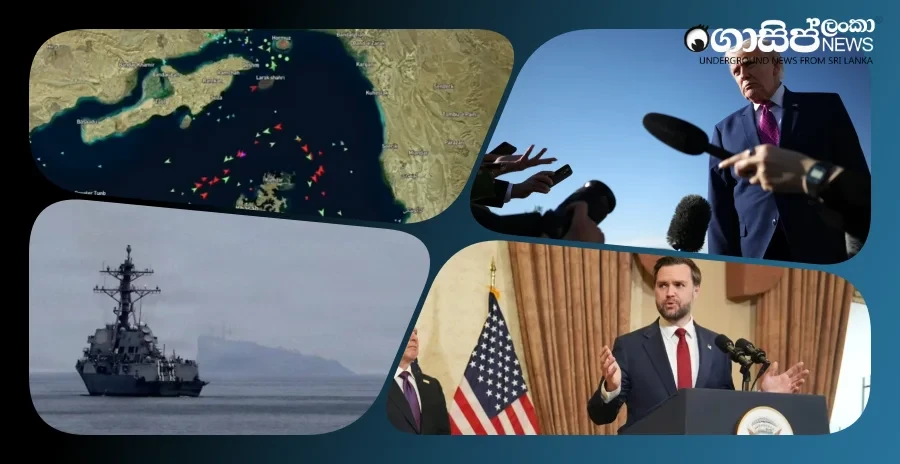
By the 46th day of the war between the United States and Israel against Iran, the American military has officially commenced operations to completely blockade Iranian ports and coastal areas. These naval blockades, which began around 10:00 AM American time on April 13th, subject vessels entering and exiting Iranian waters to strict inspection.
However, the US Central Command has confirmed that there are no obstructions for other commercial vessels transiting through the Strait of Hormuz. The Chinese-flagged vessel 'Rich Starry', which is subject to American sanctions, was allowed to pass through the strait, but American forces detained the 'Elpis' vessel, which was transporting Iranian crude oil, for approximately six hours in the Gulf of Oman. This situation has raised concerns regarding international maritime law and created a severe crisis in this sea lane, through which approximately 20% of the world's crude oil supply passes.Regarding these naval blockades, US President Donald Trump has been issuing statements of a dual nature. He issued a strong warning that if Iranian warships approached American forces, they would face a "swift and severe" attack. However, a few hours later, he stated that Iranian authorities had called him by phone and expressed willingness to reach some agreement. This blockade, which targets only Iranian ports instead of completely closing the Strait of Hormuz, is the latest strategy adopted by the US after the breakdown of the Islamabad talks. Meanwhile, US Vice President J.D. Vance strongly criticized Iran's actions, calling them "economic terrorism."
Iran has strongly condemned this US naval operation as an act of "maritime piracy" and an illegal restriction of international maritime boundaries. The naval branch of the Iranian Revolutionary Guard Corps (IRGC) warned that foreign warships near its maritime borders would face severe consequences. Thousands of people in Tehran protested against this US action, and anti-American sentiments are being heavily propagated through state media. Iranian Oil Minister Mohsen Paknejad stated that Iranian oil sales have remained at a favorable level since the start of the war. Furthermore, with initial damages exceeding $270 billion, Iran has reiterated its condition for war reparations in any future discussions.
Amidst this tense atmosphere, Pakistan has once again offered to mediate for a diplomatic solution. Accordingly, they have proposed holding a second round of talks between the US and Iran in Islamabad in the coming days. The Prime Minister of Qatar and Saudi Arabia are also working together to solidify this fragile ceasefire and foster peaceful dialogue. Meanwhile, China has condemned the US naval blockade as a dangerous and irresponsible act, urging all parties to respect the ceasefire. The importance of ensuring freedom of international maritime navigation has also been emphasized by UN Secretary-General António Guterres.
These latest developments have also had a direct impact on the global economy. Crude oil prices in the world market have fallen due to investors' hopes that talks will resume and the naval blockade not being fully implemented. Accordingly, the price of a barrel of American crude oil has decreased by 1.7% (to $97.37), and Brent crude oil by 0.9% (to $98.49). Concurrently, Asian stock market indices, Nikkei, have risen by 2.3%, and Kospi by 2.7%. However, economic analysts warn that if this situation escalates further, a long-term supply risk could emerge.
Concurrently with the attention-grabbing events in the Strait of Hormuz, clashes are also being reported in Southern Lebanon. Israeli military airstrikes on the areas of Ayta ash-Shab, Kalaoiyya, Nabatieh, and Shabriha have resulted in four deaths and several injuries. In response, Hezbollah has launched rocket and drone attacks on northern Israel. Hezbollah rejected the upcoming talks in Washington regarding Lebanon, firmly stating that the government must defend the country against Israeli aggression. These parallel conflicts indicate that, even amidst the American-Iranian naval blockades, the multi-faceted and regional expansion of this war remains active.