![Gossip Lanka News [English]](https://blogger.googleusercontent.com/img/a/AVvXsEhYm2aFFq-bIW1nWX-RrqnPFoIsVos6_VCVz8BpLt0QJi55GNXHXC2fugeRvL0qUStEuCfs7Sfu6ZiSlhrkldxfGuE_wzy5gitY6rMZ2KSi8VBbGvkgXLks37RwZV-4-HKbWiNLRxB8C_r1e4z3mpxFTMPDJPEADoG8E-bZteWFipeD5KNGbjvCfqEfKw=s300 "Gossip Lanka News [English]")
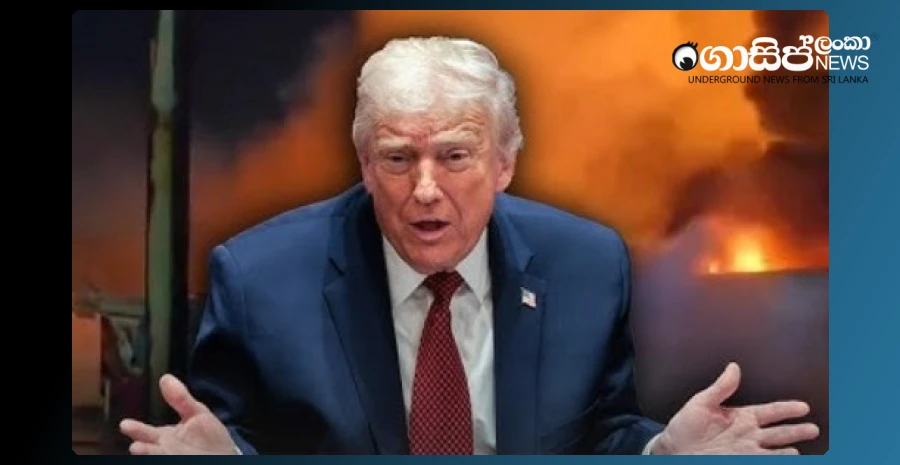
On February 18, when US President Donald Trump was deciding whether or not to attack Iran, US Energy Secretary Chris Wright stated that he was not concerned that a war would severely impact the Middle East's oil supply or the oil market. He pointed out that even when Israel and the US attacked Iran in June last year, there was no significant impact on the oil market, and although oil prices rose slightly, they quickly recovered.
Trump's other advisors also privately believed that warnings about Iran blocking sea lanes, through which about 20% of the world's oil supply travels, were exaggerated.However, with Iran's threat to attack oil tankers passing through the Strait of Hormuz, that American assessment has now proven to be completely wrong. Commercial shipping in the Strait of Hormuz, the main sea lane for all ships exiting the Persian Gulf region, has now almost completely stopped, and as a result, the price of a barrel of crude oil reached the $110 mark at one point. Due to this crisis, fuel prices have also risen in the US, and the Trump administration is currently looking for alternative ways to control this economic impact.
This situation makes it clear that President Trump and his advisors have misunderstood Iran's stance on the war. Iran views this conflict as a threat to its existence, and this time they have shown a much more aggressive response than the 12-day war in June last year. Iran has launched missile and drone attacks targeting US military bases, cities in Arab countries in the Middle East, and populated areas in Israel. In the face of these attacks, US officials had to immediately change their plans, including evacuating some embassies and formulating new policies to control fuel prices. Additionally, on March 11, a Thai cargo ship passing through the Strait of Hormuz was also attacked.
It has now been revealed that the Trump administration has no definite plan to end this war. Democratic Senator Christopher Murphy stated on social media that the government has no plan to safely reopen the Strait of Hormuz, following a secret discussion held on Tuesday for American lawmakers. As the President continuously declares that the military operation is completely successful, officials, despite their frustration over the lack of a plan to end the war, refrain from directly telling the President. Although Trump's goal is to install a leader in Iran who is subservient to the US, Secretary of State Marco Rubio and Defense Secretary Pete Hegseth hold a different view, pointing out that America's main objective should only be to weaken Iran's missile and military capabilities. The Defense Secretary has also admitted that the Pentagon was unable to fully assess the intensity of Iran's strong response in advance.
President Trump has expressed strong displeasure regarding the disruptions to oil supply, stating that oil tanker crews should 'be a little brave' and pass through Hormuz. Although Trump had instructed to prepare alternatives such as providing insurance coverage to shipping companies and US Navy protection to deal with rising oil prices, no such naval protection program has been initiated yet. A false statement made by Energy Secretary Chris Wright on social media on March 10, claiming that the US Navy had provided protection to an oil tanker, also caused market instability. Additionally, US intelligence agencies have received information that Iran has laid sea mines in the Strait of Hormuz, and the US military attacked 16 Iranian ships that were preparing to lay mines on Tuesday.
Republican leaders in Washington are deeply concerned about the US Mid-term elections scheduled for November due to rising fuel prices. To address this crisis, Trump has focused on obtaining Venezuelan oil and has also announced a new refinery in Texas to boost future supplies. However, Trump has been issuing contradictory statements regarding the duration of the war, and the Pentagon has revealed that the US used weapons worth $5.6 billion in only the first two days of the war. Meanwhile, Ali Larijani, a senior official of Iran's National Security Council, has warned that the Strait of Hormuz will either be a path of peace and prosperity for all, or a path of defeat and sorrow for those who seek war.
Meanwhile, preliminary investigations have confirmed that the US is responsible for the missile attack on a primary school in Minab, Iran. According to US military investigations, the school was mistakenly identified as a military base due to the use of outdated data. More than 160 schoolchildren were killed in this tragic attack, which was carried out using a Tomahawk cruise missile on February 28.