![Gossip Lanka News [English]](https://blogger.googleusercontent.com/img/a/AVvXsEhYm2aFFq-bIW1nWX-RrqnPFoIsVos6_VCVz8BpLt0QJi55GNXHXC2fugeRvL0qUStEuCfs7Sfu6ZiSlhrkldxfGuE_wzy5gitY6rMZ2KSi8VBbGvkgXLks37RwZV-4-HKbWiNLRxB8C_r1e4z3mpxFTMPDJPEADoG8E-bZteWFipeD5KNGbjvCfqEfKw=s300 "Gossip Lanka News [English]")
The global energy market is facing a severe crisis with the escalation of the war situation between the United States, Israel, and Iran in late February and early March 2026. Particularly, disruptions around the Strait of Hormuz, attacks on oil infrastructure, and the hindrance of shipping and oil production in the Middle East have caused the price of a barrel of global crude oil to frequently and significantly exceed the $100 mark.
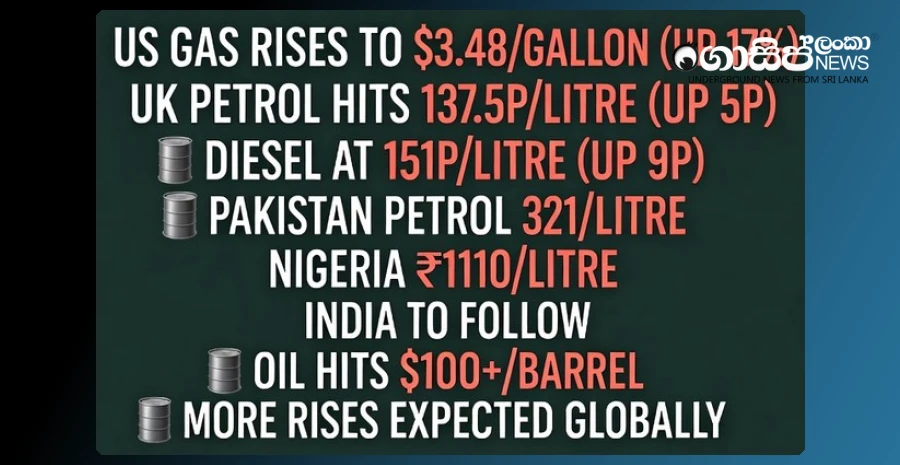
In this situation, petrol and diesel prices have rapidly increased in the domestic markets of fuel-importing countries, and despite government subsidies, the impact is severely felt by consumers. In the United States, gasoline prices have risen by about 17%, with a gallon increasing from $2.98 to $3.48 in many areas, and diesel prices have increased by about 23%, as a direct market response to the higher crude oil prices. Concurrently, in the United Kingdom, the price of a liter of petrol has risen by 4-5 pence (up to 137-140 pence), and a liter of diesel by 8-9 pence (up to 151 pence), and these values are expected to increase further if crude oil prices remain high.
It is reported that this fuel crisis has severely affected countries in the Asian and African regions. In Pakistan, the price of a liter of petrol has risen by about 21% to 321 rupees, leading to people queuing and massive protests against it. Neighboring India is also facing public protests due to the increase in household gas (LPG) prices, but its government appears to be making some efforts to keep petrol and diesel prices stable. Additionally, due to the impact of the Strait of Hormuz, fuel prices in Ghana have also increased since early March, and in Nigeria, the price of a liter of fuel rising from 950 to 1110 Naira within a few days has sparked intense public discussion about the war situation and global factors.
In some parts of Western Europe, the price of a liter of diesel has increased by about 30 euro cents, and similar situations are reported from countries like China and the Netherlands. However, Indonesia has increased the amount of subsidies provided to cope with this situation, and South Korea is planning to set a maximum retail price for fuel to protect consumers. Although this crisis has severely affected importing countries, major oil-producing countries such as Saudi Arabia, the United Arab Emirates, and Iran have managed to maintain stability in their countries by keeping fuel price increases at a minimum of between 4% and 7%. Given the constantly changing war situation, there is significant instability in crude oil prices, and even though many governments have not officially announced price increases, the pressure of rising fuel prices due to market influence is directly impacting the general public.