![Gossip Lanka News [English]](https://blogger.googleusercontent.com/img/a/AVvXsEhYm2aFFq-bIW1nWX-RrqnPFoIsVos6_VCVz8BpLt0QJi55GNXHXC2fugeRvL0qUStEuCfs7Sfu6ZiSlhrkldxfGuE_wzy5gitY6rMZ2KSi8VBbGvkgXLks37RwZV-4-HKbWiNLRxB8C_r1e4z3mpxFTMPDJPEADoG8E-bZteWFipeD5KNGbjvCfqEfKw=s300 "Gossip Lanka News [English]")
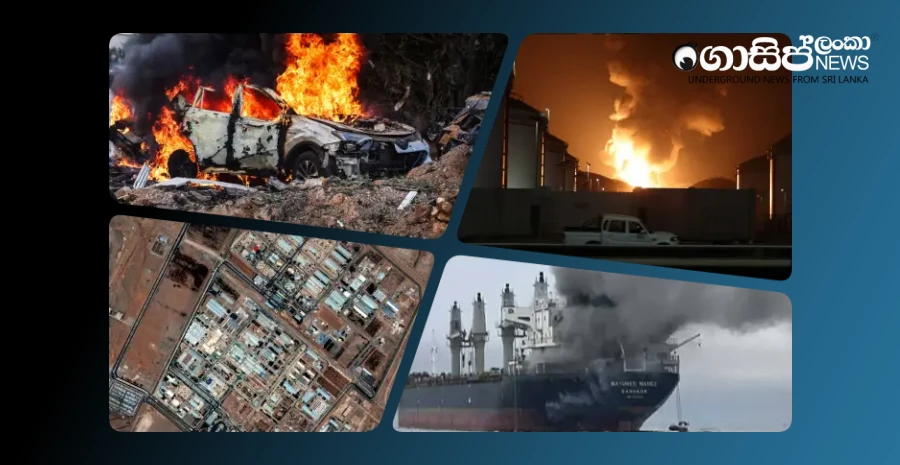
The American-Israeli and Iranian war, which began on February 28, 2026, has now entered its 32nd day, March 30-31, 2026, taking on a highly offensive character. Over the past 24 hours, Iran has continuously launched missile and drone attacks on Israel and American targets in the Gulf region, and in response, the United States and Israel have launched a series of intense airstrikes targeting Iran's nuclear and military strongholds.
From last night until dawn on March 31, Iran launched numerous ballistic missile attacks with 'MIRV' technology targeting central areas of Israel. These attacks caused severe damage to Tel Aviv, a synagogue in Bnei Brak, as well as the areas of Petah Tikva and Givat Shmuel. It is reported that 6 to 11 people were injured due to the debris and fires from the attacks, as well as while running to safety. Although Israel's multi-layered air defense systems, Iron Dome and Arrow, managed to destroy many missiles, strategic analysts point out that some missiles landing in populated areas demonstrate Iran's penetration capability.
On the other hand, American and Israeli forces have launched powerful bunker-buster munitions attacks on Isfahan, where a major Iranian nuclear and missile production center and the Badr airbase are located. Massive explosions and fires were reported here, along with power outages in Tehran and Alborz provinces. Additionally, attacks on the Mahallat area killed 11 people and injured 15, while an attack on a civilian contract site in the Qasr-e Shirin area killed one person and injured 8 others. The Israel Defense Forces (IDF) have confirmed that approximately 400 munitions were used to destroy about 170 Iranian missile and nuclear targets in the past 24 hours alone, and the Islamic Revolutionary Guard Corps (IRGC) has vowed strong retaliation.
Iran has also intensified its naval and drone operations in the Persian Gulf region. An Iranian drone attack on the Kuwaiti-owned oil tanker 'Al-Salmi' anchored in Dubai port caused a fire, but no one was harmed, and no oil spill was reported. Additionally, Iran claims to have successfully attacked an Israeli container ship in the Arabian Gulf, American Marines near a coastal base in the United Arab Emirates, the anti-drone system of the American Fifth Fleet in Bahrain, and two early warning radar systems at a Kuwaiti base. An attack on Saudi Arabia's Sultan Air Base severely damaged an American reconnaissance aircraft, and two people in the Al-Kharj area were injured by falling debris.
The impact of this conflict has now spread to Lebanon, with four Israeli soldiers killed during operations in southern Lebanon. Similarly, four Lebanese civilians have died in the Tyre and Derikifa areas due to Israeli drone attacks. Meanwhile, the disruption of maritime traffic in the Gulf region and the instability of stock markets have raised the risk of a global energy crisis, prompting China and Egypt's Al-Azhar institution to call for an immediate de-escalation of the situation.
Diplomatically, the crisis has also intensified. Although American President Trump expressed a preference for a diplomatic solution, US Secretary of State Marco Rubio told Al Jazeera that Iran would face severe consequences if the Strait of Hormuz is not fully opened. Iranian President Masoud Pezeshkian rejected these American demands as unrealistic. Meanwhile, Israeli Prime Prime Minister Benjamin Netanyahu stated that more than half of their military objectives in Iran have been completed. Saudi Arabia, Qatar, and Jordan condemned the Iranian attacks at a summit in Jeddah, and Spain has closed its airspace to American military aircraft involved in Iranian operations. Furthermore, a brief entry of an Iranian missile into Turkish airspace has raised the risk of NATO intervention in this war.