
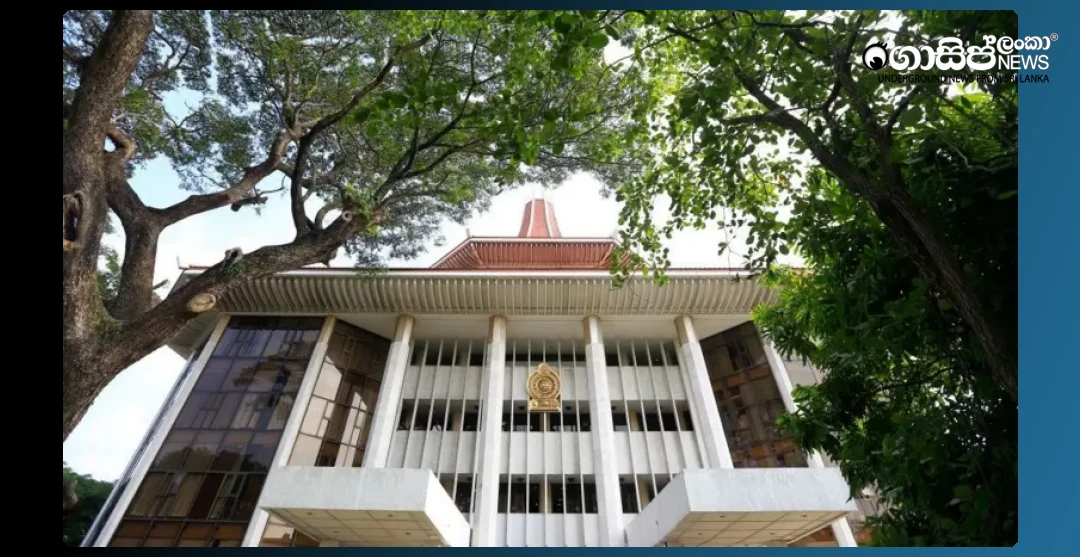
The Attorney General yesterday (09) informed the Supreme Court that it has been decided to completely remove six controversial provisions included in the 'Prevention of Organized Crime Bill', which had led to severe controversy.
This notification was made by Solicitor General, President's Counsel Viraj Dayaratne, who appeared on behalf of the Attorney General, when the petitions against this bill were taken up for hearing before a three-member Supreme Court bench comprising Chief Justice Preethi Padman Surasena, Achala Wengappuli, and Sampath Abeykoon.
According to this notification from the Attorney General, the main provisions removed from the bill include the power to search houses without a warrant, the power to arrest for excise offenses and copyright infringement, and the requirement to obtain permission for reporting serious crimes. In addition, the provision for arresting a person with tattoos on their body identifying them as an organized criminal has been completely removed, and the period for detaining a suspect in police custody has been reduced from 72 hours to 48 hours. The provision for searching without a warrant has been removed and replaced with a provision for searching a house with a search warrant.
President's Counsel Romesh de Silva, appearing for the petitioners, pointed out to the court that while the most important amendments to the bill should concern provisions on detention orders and bail, nothing about them was mentioned in the initial submissions. The Chief Justice, paying attention to this argument, took steps to adjourn court proceedings for an hour to further discuss the matter.
When the court reconvened after an hour, the Solicitor General provided a detailed explanation of the bill's amendments, emphasizing that the primary objective of this bill is to ensure national security as well as economic stability. He clarified that since old methods of preventing organized crime have become outdated, modern ideas and methods, similar to those implemented in countries like Singapore in accordance with United Nations conventions, are being introduced through this bill. He further stated that he expects to present the relevant amendments and to seek further advice from policymakers on this matter.
The Solicitor General also responded to the point raised by President's Counsel Romesh de Silva that the bill creates a risk of arresting four individuals merely for discussing together. He stated that such individuals would only be arrested if they act with the intention of committing an organized crime, and that this bill would allow for the prevention of mafia gangs.
Furthermore, the Solicitor General pointed out that a person can only be detained under detention orders for a maximum of two months, and if this period is to be extended further, the discretion of a High Court judge is mandatory, confirming that judicial power has in no way been undermined by this. He also pointed out that no provision of the bill violates the fundamental right to equal treatment under the Constitution. He further informed the court that if there are any ambiguities or confusing situations, steps would be taken to clarify them through written submissions.
These petitions were filed by the Bar Association of Sri Lanka, Distilleries Company, and others, stating that this bill is contrary to the Constitution and requesting an order for it to be passed by a referendum and a special majority vote of members.
Appearing for the petitioners were President's Counsels Sanjeevi Jayawardena, Saliya Peiris, M.A. Sumanthiran, Iraj Silva, Ali Sabry, and Naveen Marapana, as well as attorneys Suren Gnanaraj, Lakshan Dias, Rukshan Senadheera, and Ruwantha Kure. Appearing for the Attorney General, along with the Solicitor General, were Deputy Solicitor General Suharshi Nerath, Dr. Avanthi Perera, and Additional Solicitor General Sudarshana de Silva.
Considering the submissions made, the Supreme Court ordered both parties to file their written submissions by the 11th of this month and informed that the court's decision on the bill would be forwarded to the Speaker in due course.