
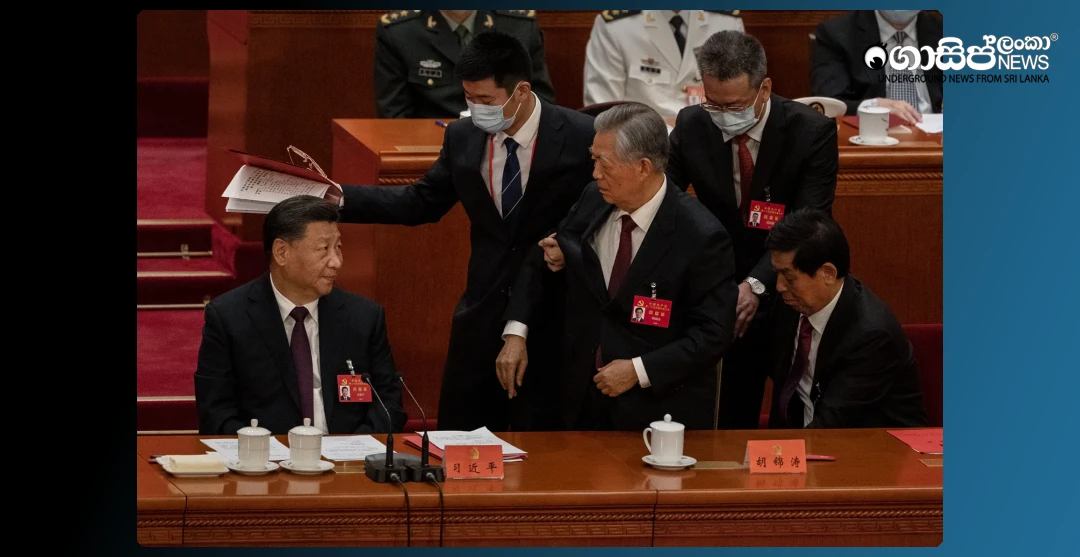
The crackdown implemented by Chinese President Xi Jinping within the Chinese Communist Party has now taken on a more severe form. Believing that the weakening of party discipline and ideological strength is the main reason for the problems within the Chinese bureaucracy, he has introduced a self-revolution, including continuous inspections and self-criticism, as a remedy.
The President has likened corrupt officials to diseased trees that must be uprooted or cut down.Operating the mechanism of the Communist Party, which has over 101 million members, is part of the President's main agenda. According to official statistics, in 2023 alone, 49 provincial or ministerial-level officials and 24,000 local-level officials were punished. In 2022, these numbers were 69 and 35,000 respectively. Ling Li, a lecturer in Chinese Politics and Law at the University of Vienna, points out that this anti-corruption campaign has now become a completely normalized process.
Recently, the Chinese military has been most severely affected by this purification process. Earlier this year, Zhang Youxia, one of China's top military generals, was detained on charges of corruption and disloyalty. Since 2022, nearly a hundred senior military officials have either been investigated or have suddenly disappeared, with the majority of them still under investigation.
Against the backdrop of severe impacts on local government revenue streams due to economic recession and the collapse of the property market, this pressure on officials is expected to intensify further ahead of next year's Party Congress. Political analysts suggest that instilling fear among officials when the Party Congress convenes will facilitate reaching a common consensus in decision-making.
This crackdown has also extended to former senior politicians and officials. Huang Qifan, the 74-year-old former mayor of Chongqing who retired eight years ago, and Xia Linmao, the deputy mayor of Beijing, were recently investigated on charges of violating party discipline.
A more noteworthy point is that even close associates of 78-year-old Wang Qishan, the former head of the Central Commission for Discipline Inspection who successfully led the first phase of President Xi's anti-corruption campaign, are now targets. Financial official Zhou Liang and disciplinary official Li Xiaohong have been detained on corruption charges, while another former aide, Dong Hong, was imprisoned in 2022. Additionally, two more of his former aides have been demoted by the Central Commission for Discipline Inspection this year.
It is speculated that the President's suspicion regarding the political influence of retired officials is the reason for this. Jonathan Zin, a researcher at the Brookings Institution in America and a former official of the Central Intelligence Agency, points out that despite playing a significant role in achieving the President's objectives, Xi Jinping believes that powerful individuals like Wang Qishan could pose a threat to him in the future.
However, the adverse consequences of this continuous crackdown are now emerging. A recent study revealed that the morale of millions of junior officials has plummeted, and they are avoiding taking significant risks in decision-making. According to Professor Benjamin Hillman of the Australian National University, many officials are forced to artificially present results, especially because local governments in rural areas lack the necessary resources to meet the stringent demands from the central government.