
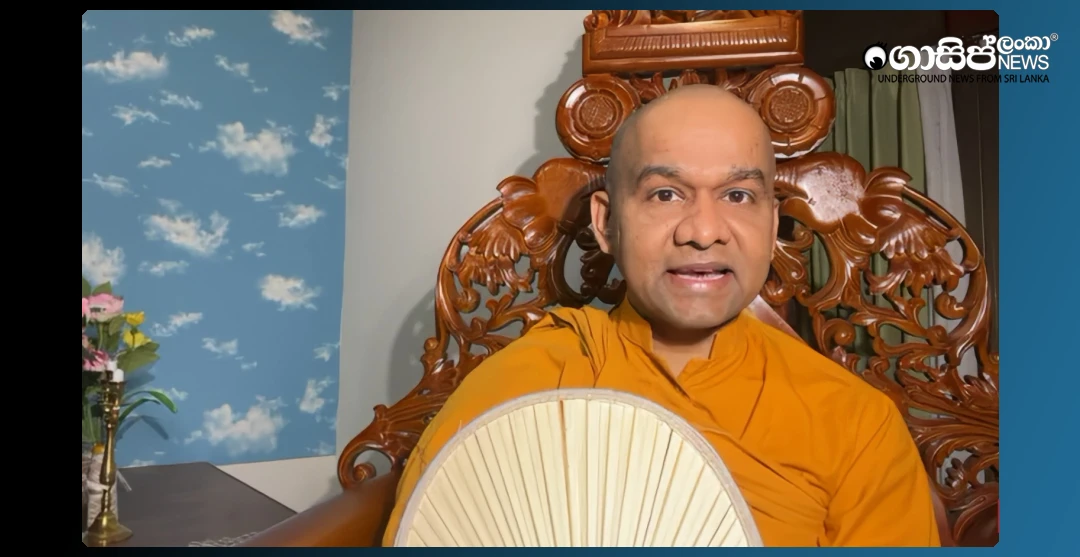
Currently, there is a significant debate in society regarding the true role of a Buddhist monk. Especially in a context where people are divided and express various opinions on the different behaviors and social interventions of some monks through social media, a timely Dhamma discourse was recently held in Japan, elucidating the true responsibility of a Buddhist monk based on the Sigalovada Sutta.
This discourse was delivered by the Venerable Mawarale Bhaddiya Thero at the Kanagawa Sugatha Meditation Center located in the Kanagawa region of Japan. It was broadcast via the 'Buddha Puthun' Facebook page and YouTube channel.
As Bhaddiya Thero pointed out, according to the Sigalovada Sutta of the Digha Nikaya, the primary duty of a monk towards lay society is to unconditionally free society from evil (papa nivarenti). People cannot be prevented from evil merely by administering the Five Precepts or by enacting laws. Instead, what should be done is to point out the consequences of unwholesome actions, awaken people's wisdom, and foster a sense of shame and fear of evil (hiri ottappa) in society. Although some people currently expect various wonders and miracles from monks, the Blessed One, in suttas like the Brahmajala Sutta, only valued the 'Anusasani Pratiharya' (miracle of instruction), which is teaching the Dhamma to develop people's wisdom. While social service, helping the destitute or the sick, can be done by a monk, he strongly emphasized that these are their secondary tasks, not their primary responsibility.
Secondly, the monk should encourage the layperson to engage in wholesome actions (kalyane nivesenti). This should not be limited merely to meritorious deeds such as the eight great meritorious actions, building temples, or offering alms. Beyond that, guiding the layperson towards the practice of the Four Foundations of Mindfulness (Satipatthana) is the true role of a monk. He explained that guiding people to develop their concentration through contemplation of the body (kayanupassana), feelings (vedananupassana), mind (cittanupassana), and mental objects (dhammanupassana) is leading them to true wholesome action. Providing the necessary guidance to overcome lust (raga), hatred (dvesha), and delusion (moha) is the primary assistance a layperson should expect from a monk. To free a person who is attached to unwholesome actions in such a way that they cannot see their own faults, the guidance of a correct teacher is essential.
Furthermore, two other primary duties that a monk should fulfill for society are teaching Dhamma sections that the layperson has not heard before (asutam saventi) and further clarifying and stabilizing Dhamma points that are already known (sutam pariyodapenti). Maha Brahma Sahampati invited the Buddha to preach the Dhamma precisely because there are wise beings in the world capable of understanding this profound Dhamma. Instead of merely exploiting social issues or criminal incidents like ordinary YouTubers on social media today, a monk should explain the causes of such social problems in accordance with the Dhamma and reveal the reality.
Here, a wonderful analogy was presented regarding the use of social media and monastic boundaries. Just as a quail is safe from a hawk as long as it stays in the mud, a monk is safe as long as they remain in their proper sphere, which is the Four Foundations of Mindfulness (Satipatthana). Bhaddiya Thero pointed out that unnecessarily overstepping these boundaries into social media or lay affairs is the beginning of a monk's downfall. Today, some individuals, immediately after ordination, abandon their teacher and become isolated, thereby bringing disgrace upon the Sasana as well as themselves. To prevent this situation, he suggested that it is mandatory for anyone who ordains to train under a wise teacher for at least five years.
Problems within the Sasana cannot be solved merely by enacting laws or blaming the Mahanayaka Theros. The understanding of lay society is also extremely important for this. Laypeople should only follow monks who free them from evil, guide them towards wholesome actions, lead them to the Four Foundations of Mindfulness, and teach them unknown Dhamma. In situations where this is not the case, instead of creating unnecessary conflicts on social media and corrupting one's mind, it is the responsibility of the layperson to intelligently withdraw from such situations, he explained.
Finally, the ultimate goal of a monk is to guide the layperson towards a good rebirth and Nibbana (saggassa maggam acikkhanti). Its supreme aspiration is to reveal the path to liberation from the suffering of samsara with loving-kindness and compassion.