![Gossip Lanka News [English]](https://blogger.googleusercontent.com/img/a/AVvXsEhYm2aFFq-bIW1nWX-RrqnPFoIsVos6_VCVz8BpLt0QJi55GNXHXC2fugeRvL0qUStEuCfs7Sfu6ZiSlhrkldxfGuE_wzy5gitY6rMZ2KSi8VBbGvkgXLks37RwZV-4-HKbWiNLRxB8C_r1e4z3mpxFTMPDJPEADoG8E-bZteWFipeD5KNGbjvCfqEfKw=s300 "Gossip Lanka News [English]")
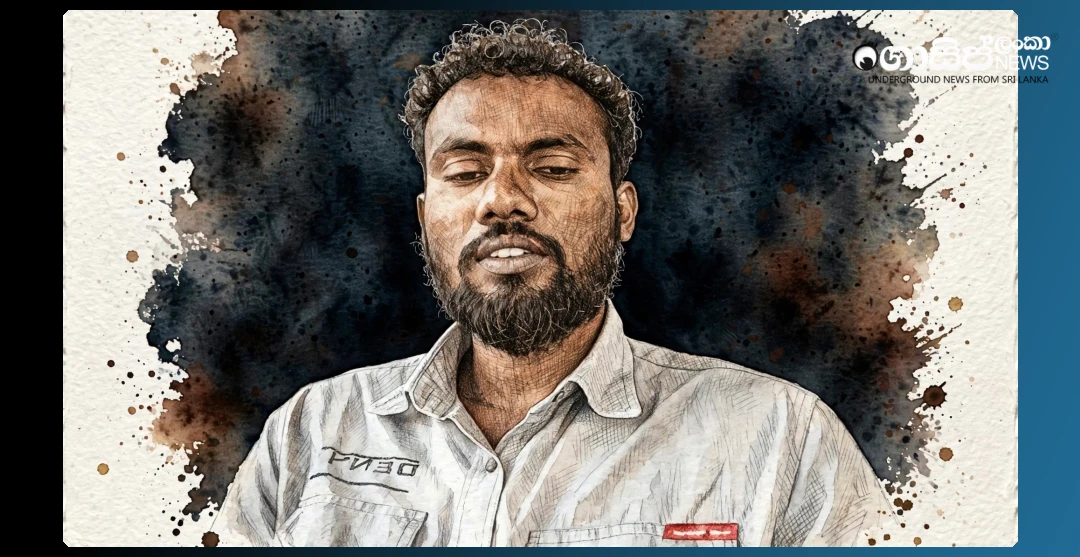
The life of a twenty-seven-year-old Sri Lankan youth oscillated between a Facebook post written by mistake in a few seconds and an apology video posted ten minutes later after deleting it. The death penalty imposed by the Saudi Arabian Court of Appeal against Anojan Sivarasa, who was working in Saudi Arabia, was overturned this week by the Saudi Supreme Court, as a result of a massive operation by a team of lawyers and diplomatic officials from Sri Lanka.
The main turning point in saving his life was the "ambiguity" in a few words contained in the confession he allegedly made during the initial trial.This series of unfortunate events began on June 28th. Around 10:00 PM that day, during an exchange of words on the Facebook social media network, Anojan posted a note that severely defamed Prophet Muhammad. Within ten minutes, he deleted it and released an apology video, but on July 2nd, the Saudi police arrested him. A case was filed on July 14th, and on July 26th, it was referred to the Public Prosecutor of Saudi Arabia.
The next day, July 27th, he was summoned before the Second Circuit of the Al-Ahsa Criminal Court, which is a court of first instance that hears cases related to Sharia law and other offenses. Anojan, who had not received any legal assistance at that time and had not contacted the Sri Lankan Embassy, pleaded guilty before the court. According to official documents, he was charged under Sharia law for defaming Prophet Muhammad, disseminating information that undermines religious values via the internet, and under Article 6 of the Anti-Cybercrime Law. On July 28th, he was sentenced to five years in prison and a massive fine of three million Saudi Riyals (262.6 million Sri Lankan Rupees). His phone was confiscated, and his Facebook account was closed. The Sri Lankan Embassy in Riyadh intervened after learning about the incident through media reports.
Subsequently, Anojan filed an appeal against his sentence with the 7th Criminal Circuit of the Eastern Province Court of Appeal, and the Public Prosecutor also filed an appeal, stating that the sentence was insufficient and should serve as a lesson to others. Anojan, appearing before the Court of Appeal with a lawyer provided by the Sri Lankan Embassy, accepted his original confession and stated that he had nothing new to add. On September 17th, the Court of Appeal announced its verdict, changing his sentence to a "Hadd" punishment and sentencing Anojan to death. According to traditional Islamic Sharia law, 'Hadd' is a mandatory punishment prescribed for specific serious crimes that violate the rights of God. Judges have no power to mitigate or pardon these punishments, which are based on the Quran or the traditions of the Prophet, and even the Saudi King cannot grant a pardon. Its implementation requires a direct confession or eyewitness testimony, and it cannot be enforced if there is reasonable doubt.
To save Anojan's life, a swift diplomatic operation was launched by embassy officials led by the Sri Lankan Ambassador to Saudi Arabia, Mr. O.L. Ameer Ajwad, and a team including Consul General Judge Mohamed Laffar from Jeddah. Simultaneously, a team of lawyers from Sri Lanka also arrived in Saudi Arabia to represent him. It is noteworthy that the private lawyers in this team, comprising President's Counsel Upul Kumarapperuma, President's Counsel Faizer Mustapha, Additional Solicitor General Asad Navavi, and lawyer Hafeel Faris, voluntarily represented Anojan, bearing all expenses themselves.
"This outcome was achieved due to the relentless efforts of the Ambassador and other officials, and our legal intervention," stated lawyer Hafeel Faris. The legal team presented several strong arguments to the Supreme Court regarding the Court of Appeal's decision. The first was that Anojan was not informed that he was confessing to a 'Hadd' offense, which carries the death penalty, when the Court of Appeal changed the charge from a cybercrime to a 'Hadd' offense. Although Article 158 of the Saudi Code of Criminal Procedure states that the nature of the charge must always be communicated to the defendant, this did not happen in the Court of Appeal. The lawyers argued that when imposing a 'Hadd' punishment, both the offense and the law must be free from any ambiguity.
They built a compelling argument to highlight the ambiguity in Anojan's original confession. The Arabic confession recorded in the Al-Ahsa court stated that he admitted to defaming "our Prophet Muhammad." The lawyers pointed out that since Anojan is a Hindu, he would never use the phrase "our Prophet," and that these were the words of his translator. They also explained that among the four main schools of Islamic Sharia law – Shafi'i, Hanafi, Maliki, and Hanbali – only one scholar from the Hanbali school in the 13th century stated that a non-Muslim who defames the Prophet should be given the death penalty, while the other three schools do not agree with this. They also presented examples to the court from the Prophet's teachings where he forgave those who insulted him. Furthermore, they questioned why the Court of Appeal resorted to Sharia law when there are specific provisions for religious defamation under cybercrime law.
The appeal was filed online with the Supreme Court on October 11th (for which the embassy had appointed a new lawyer under the provisions of the Sri Lankan Ministry of Foreign Affairs), and two days later, on the night of October 13th, the legal team was informed that the Court of Appeal's decision had been overturned. Thus, the death penalty imposed on Anojan was removed, but Mr. Faris stated that the next legal steps, including the original court's verdict, still need to be clarified.
Concluding the mission to save Anojan's life and returning to their homeland was also a major challenge for the legal team. Due to attacks on Riyadh Airport on October 8th, international flights had been suspended. On October 10th, lawyer Hafeel Faris departed from Riyadh's domestic terminal for Jeddah and then traveled to Colombo. A few hours later, the same terminal bound for Jeddah was also attacked, killing sixteen passengers and injuring over 300 people. The other members of the team managed to obtain emergency visas and travel by road to Doha, Qatar, and then to Colombo. The massive legal battle launched for one life concluded, leaving behind a thrilling experience where several other lives narrowly escaped danger.