
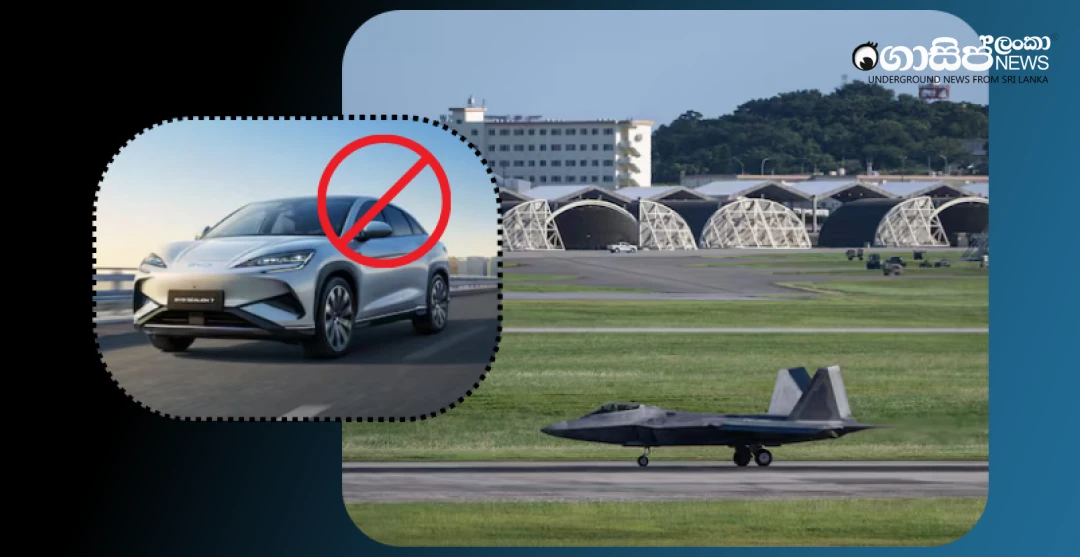
The entry of vehicles from BYD, China's leading electric vehicle (EV) manufacturer, has been completely banned at Kadena Air Base, an American air force base located in Okinawa, Japan. This decision, announced on the 23rd based on security risks, is scheduled to come into effect on the 26th, marking the first instance where Chinese electric vehicles have been restricted from entering a US military base located in a foreign country due to confidentiality concerns.
With this order, steps have been taken to deploy security personnel at all entry gates of Kadena Air Base. Instructions have been given to block and immediately turn back any arriving BYD vehicle. This ban applies equally to all BYD vehicles, including private vehicles, contractor vehicles, and taxis. This measure is interpreted as being taken with the aim of preventing the leakage of military information externally through the cameras, sensors, GPS devices, and other advanced technologies present in electric vehicles.
Kadena, the largest US Air Force base outside of America, is a critical hub operating in the Pacific region for the defense of Japan and to deter North Korea, China, and Russia. With the Typhon mid-range missile system, capable of deploying Tomahawk cruise missiles with a range of 1,600 kilometers, installed here, China's eastern coastal region is directly within its strike range. Additionally, the base is used as a launch center for F-22 stealth fighter jets and RC-135 reconnaissance aircraft that conduct operations targeting the Korean Peninsula.
Experts point out that this can be considered a precautionary measure taken to prevent the leakage of military operations and base-related information to the Chinese side. Due to their ability to collect large amounts of data, electric vehicles are often referred to as 'smartphones on wheels'. For example, BYD's 'Sealion 7' SUV sold in Japan is equipped with 360-degree cameras that provide live views of the surroundings. In addition, the vehicle also features infrared cameras that monitor driver attention, remote software updates for navigation systems, and microphones for voice control systems.
It is predicted that these restrictions could extend to other US military bases located in Japan or South Korea. Previously, in 2018, the US Department of Defense officially banned the sale and use of smartphones from Chinese companies like Huawei and ZTE within its military bases worldwide for security reasons.
Several other countries are currently engaged in similar preparations to prevent information leakage to China. The Polish military has prevented Chinese-made vehicles from entering its military premises since February due to security reasons. Last month, the Norwegian military confirmed that cameras installed in Chinese vehicles had video-recorded military exercises while passing through military zones. Accordingly, their attention is focused on taking further steps. Japan has also moved to tighten regulations concerning Chinese information technology equipment.
However, China was the first to initiate the operation of restricting specific vehicles from entering key facility premises. Since 2021, the Chinese military has banned Tesla vehicles from entering military facilities and major state institutions. This was due to the fact that major Tesla models are equipped with security systems that record collisions around the vehicle, external cameras, ultrasonic sensors, and internal cameras.