![Gossip Lanka News [English]](https://blogger.googleusercontent.com/img/a/AVvXsEhYm2aFFq-bIW1nWX-RrqnPFoIsVos6_VCVz8BpLt0QJi55GNXHXC2fugeRvL0qUStEuCfs7Sfu6ZiSlhrkldxfGuE_wzy5gitY6rMZ2KSi8VBbGvkgXLks37RwZV-4-HKbWiNLRxB8C_r1e4z3mpxFTMPDJPEADoG8E-bZteWFipeD5KNGbjvCfqEfKw=s300 "Gossip Lanka News [English]")
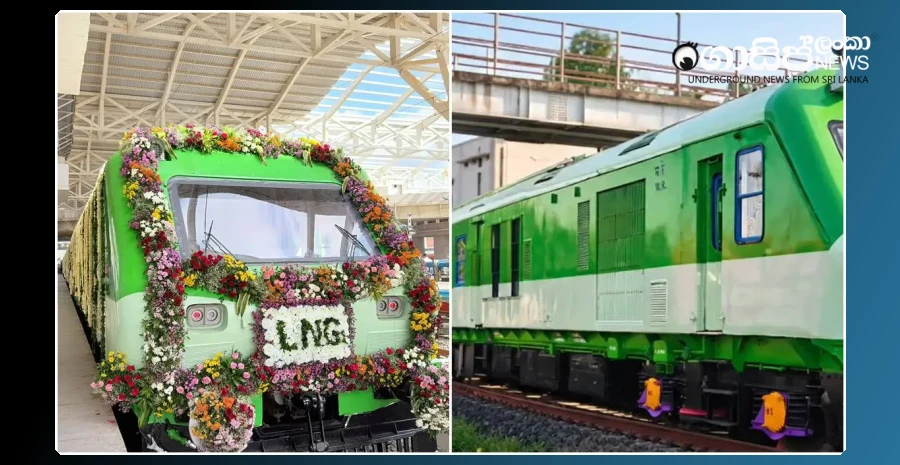
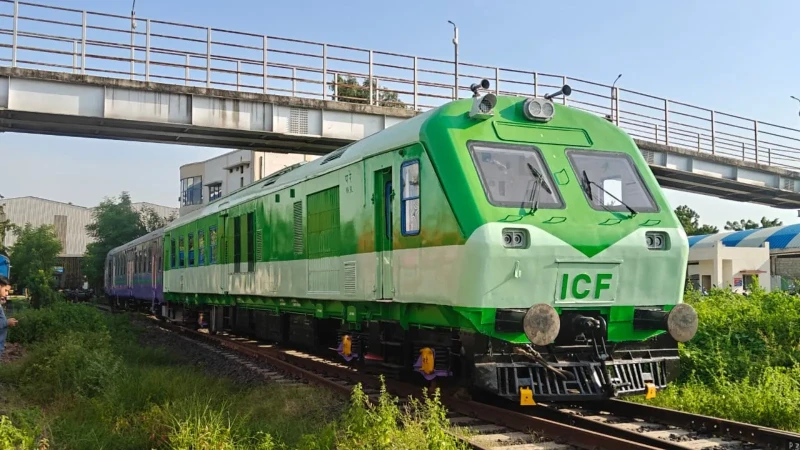
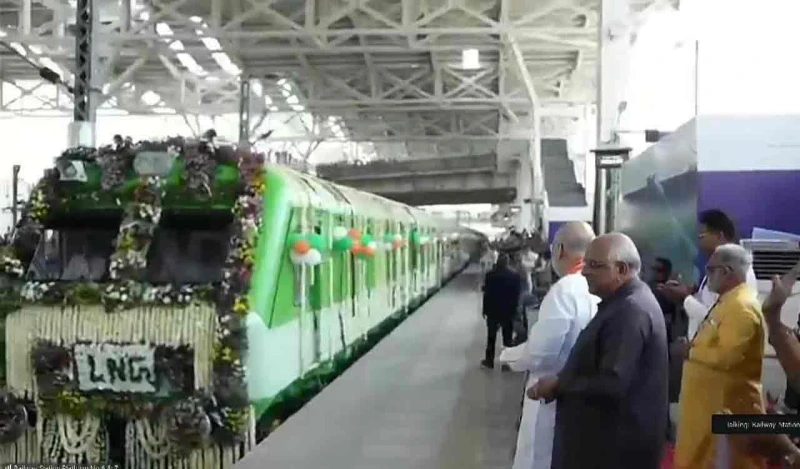
India's first liquefied natural gas (LNG) powered train commenced its journey yesterday in Sabarmati, presided over by Union Minister of Home Affairs and Cooperation Amit Shah and Gujarat Chief Minister Bhupendra Patel. This inaugural program, centered in Ahmedabad, marks the introduction of LNG as an alternative fuel for train operations, with the main objective of reducing traditional diesel usage and promoting alternative energy sources.
This new train utilizes a specially developed dual-fuel system, combining diesel and LNG, for its Diesel Power Cars (DPCs). Two 1,400-horsepower DPC coaches at the Sabarmati Integrated Coach Factory have been successfully converted to this dual-fuel system, allowing LNG to be used in parallel with diesel. Field tests covering over 2,000 kilometers have already been completed using these two DPC coaches to assess the performance and reliability of this technology. The unique aspect is that this new conversion has been carried out without any reduction in the power and operational capabilities of the standard diesel engine. Under this new system, authorities indicate that approximately 40% of the total diesel consumption can be replaced by LNG. Consequently, the use of LNG is expected to significantly reduce fuel costs as well as the emission of carbon dioxide, nitrogen oxides, and other particulate matter into the environment.
According to preliminary railway assessments, this system is expected to yield an annual saving of approximately INR 1.19 million per DPC coach and approximately INR 2.39 million for a full eight-coach train. Furthermore, this dual-fuel system allows the engine to easily switch between LNG and diesel as needed, based on fuel availability. According to technical specifications, each converted DPC coach under this system is fitted with a large LNG tank with a capacity of 2,200 liters, capable of storing 850 to 900 kilograms of usable LNG. A fully filled LNG tank provides sufficient fuel for uninterrupted operations over a distance of approximately 1,600 kilometers, thereby minimizing the need for frequent refueling.
The inauguration of this LNG train was part of a series of railway safety, signaling systems, track capacity, and infrastructure development projects worth over INR 1,542 crore, unveiled during Minister Amit Shah's visit to Ahmedabad. On the same day, the WAG-12 locomotive maintenance depot, built with an investment of INR 7 billion, was inaugurated in Sabarmati, and a WAG-12 electric locomotive was inducted into service. Overall, diesel consumption in the Indian railway sector has rapidly decreased from 2.93 billion liters in 2015-16 to 1.08 billion liters by 2024-25, with their main goal being to completely eliminate diesel usage for train operations in the future. Currently, the electrification of the entire railway network has reached 99.6%, and the annual electrification rate has seen a significant increase from 75 kilometers in 2010-11 to 7,188 kilometers by 2023-24.