![Gossip Lanka News [English]](https://blogger.googleusercontent.com/img/a/AVvXsEhYm2aFFq-bIW1nWX-RrqnPFoIsVos6_VCVz8BpLt0QJi55GNXHXC2fugeRvL0qUStEuCfs7Sfu6ZiSlhrkldxfGuE_wzy5gitY6rMZ2KSi8VBbGvkgXLks37RwZV-4-HKbWiNLRxB8C_r1e4z3mpxFTMPDJPEADoG8E-bZteWFipeD5KNGbjvCfqEfKw=s300 "Gossip Lanka News [English]")
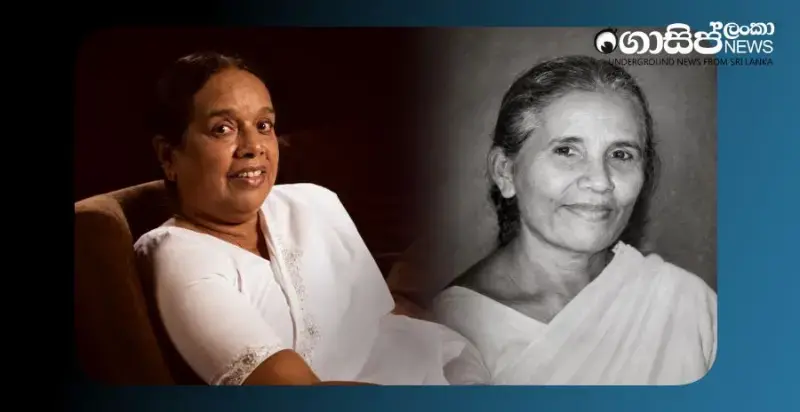
More than just a singer, this artist, who spoke up for the people, is a symbol of simplicity.
For decades, she adorned herself in white. Some time ago, she recalled memories of her mother in this way:
"My mother is Liyanage Emali Perera. Her village was Levan Duwa, Welipenna, Aluthgama.
My father was a tailor. Mirihana Arachchige Winston Perera. Although he was from the village, our family lived in Cassette Watte, Kotahena.
There were 58 line houses in this estate. We lived in a house like a small hut.
There were nine children in our family. Now one of them is no longer with us. Even though it was an urban environment with trolley buses, tram cars, and double-decker buses, we were the poorest family, even more so than other families in that society.
Many called my father 'Coat Basun' (Coat Master). The reason for this was that my father sewed coats for Hydramani Company.
My mother's village was also very difficult to access. Even though it was a beautiful village full of open fields, paddy lands, forests, and trees, a bus still cannot reach this village today.
To go to my mother's village, after taking buses to Aluthgama, Welipenna, Matugama, etc., you have to get off near Levan Duwa school and walk about three more kilometers.
Our mother's ancestral home was next to a large rock slab. During holidays, we would fly away from the concrete jungle and those rows of houses to my mother's beautiful yet difficult village.
As far as I know, my mother and father's marriage took place through an arranged system. My mother was a truly innocent mother in every sense of the word.
Devotion to her husband overflowed within her. I remember the small day I went to school. My mother sent me to Gunananda Vidyalaya, Kotahena, to learn letters.
I am the third among the children in the family. I had an older brother above me. My parents were so poor that even though we had abilities, they couldn't afford to nurture them.
Therefore, they hardly even thought about it. Even when going to the shop, I was often the one who went to get things. My mother knew very well that I could manage and bring things because I knew the household situation.
No matter how poor they were, neither my mother nor father wanted to send their children to do bad deeds or sinful acts. They didn't even teach us to ask for other people's things. If they received 10 rupees, they would try to live on those 10 rupees.
One day, when I was little, I stole two onions from the shopkeeper and came home. I committed that theft because there wasn't even a single onion at home that day.
The shopkeeper didn't see me. When my mother asked where the onions came from, I told her the truth. I don't remember a day my mother was angrier. She never even hit us with her fingernail.
But that day, my mother came in a great rage. She said, 'Count those onions.' She grabbed my hand and walked me to the shop, scolding me along the road. My mother told the shopkeeper, 'Forgive me, this girl stole three onions, look how this child is growing up,' and she snatched the onions from my hand and threw them into the box.
People watched us as we went. The shopkeeper also laughed. But everyone greatly appreciated my mother's action. From that day to this, I have never secretly taken anything that belongs to others. If my mother hadn't done that day, I would have received a wrong precedent.
At school, they called me 'Kavi Nanda' (Poet Nanda). The reason was that I would recite poems from 'Lowa Wada Sangarawa' and 'Subhashithaya' with expression at school assemblies.
My artistic life's birthplace was truly the school. Sylvester Master at school is an unforgettable name here. He is the father of Mr. Victor Wickrama, a famous stage actor.
I first developed my artistic talent at school through poetry. You might be surprised if I say acting next. I first played the character of Krishna Jina in the Vessantara play produced at school. My dear mother had the desire and interest to see these, but she didn't have enough suitable clothes to come to such a place.
She didn't consider such clothes to be important things either. But she didn't come forward and sit down, thinking her child might be embarrassed. When she came home, from the things she said about these, I felt that my mother had watched them.
When I kept questioning her about it, she said this: 'Daughter, I came to watch your performances without you or the teachers seeing me. I watched your performances hidden and enjoyed a wonderful taste.' When my mother said that, my heart swelled with affection for her.
We didn't have electricity at home. When the children sat in a row, there was no more space in the house. My elder sister served rice at our house. If my mother was given the rice to serve, she would give it all to the children without even leaving a bit of the burnt rice at the bottom of the pot.
Our mother also had a good ability to recite poetry. My mother often recalled the poems and songs she sang while doing farming work using traditional methods in the village.
Since I was the third in the family, I heard the sounds of everyone born and cradled after me. I also first understood the value of reciting poetry from my mother. My mother gave us not only education but also wisdom and intelligence. Children should worship their parents by reciting gathas.
My mother taught us that not to receive worship. The most important thing in my mother's life was simplicity. And also plainness. And also frugality. Not having excessive desires for anything.
She taught us gratitude by interacting with the people of her ancestral home during a Bak Maha festival. She taught us to interact with that well.
For the past two years, she poured water into the well first and then took a new pot. My mother wakes up early in the morning. I also adopted that habit in the same way. My mother sewed our clothes until they became too big for us.
She was a woman who never experienced unnecessary happiness or unnecessary sorrow from anything. Our father never touched cigarettes, beedis, or alcohol. But when I sang the song 'Budu Thaththe Bonna Epa' (Oh Buddha Father, Don't Drink), people would listen and say, 'Even though he puts on a show for the Vinayankal, he drinks heavily.'
My father was upset by this and asked me, 'Why did you sing that song, daughter?' But they didn't know it was a common folk song. They were that sensitive. My mother was very happy when I did 'Shravanadaraneeya Saththwa Hitha Pawana' in association with Professor Sunil Ariyaratne.
He made me understand that song is a powerful medium. My mother always stood by the side of suffering people. Therefore, that collection of songs was a comfort to her. She was not afraid.
However, when death threats came and our home radio was banned, my mother became somewhat scared. But she appreciated my socialist ideas. My mother experienced immense joy on the day Ratna Jankara Parduman was graded as a special grade singer on the radio.
I firmly believe that if there was anything that upset my mother and father to some extent, it was I who committed that mistake. Then, as now, there were popular radio programs.
My mother taught me the first lessons about life planning. The simplicity in my life, enduring everything, equanimity, and frugality – I received all these from that mother.
During the first childbirth of my youngest daughter, Ama, I had to go to London where she lived. My mother was with my youngest sister at that time. When I told my mother that I would return after three months, she said, 'Daughter, I won't die until you come back.'
After wandering at the airport for five hours, on my way back to Sri Lanka after three months, instead of going directly to see my mother, I went home with the intention of seeing her the next day. That night, I heard the painful words over the phone that my mother was having difficulty. Alas, by the time I went, my mother had already left us, lying in my sister's lap.
But just as my mother said, she did not die until I came to Sri Lanka. That is an eternal pain for me. I couldn't be with her in her last moments before her eyes closed."