![Gossip Lanka News [English]](https://blogger.googleusercontent.com/img/a/AVvXsEhYm2aFFq-bIW1nWX-RrqnPFoIsVos6_VCVz8BpLt0QJi55GNXHXC2fugeRvL0qUStEuCfs7Sfu6ZiSlhrkldxfGuE_wzy5gitY6rMZ2KSi8VBbGvkgXLks37RwZV-4-HKbWiNLRxB8C_r1e4z3mpxFTMPDJPEADoG8E-bZteWFipeD5KNGbjvCfqEfKw=s300 "Gossip Lanka News [English]")
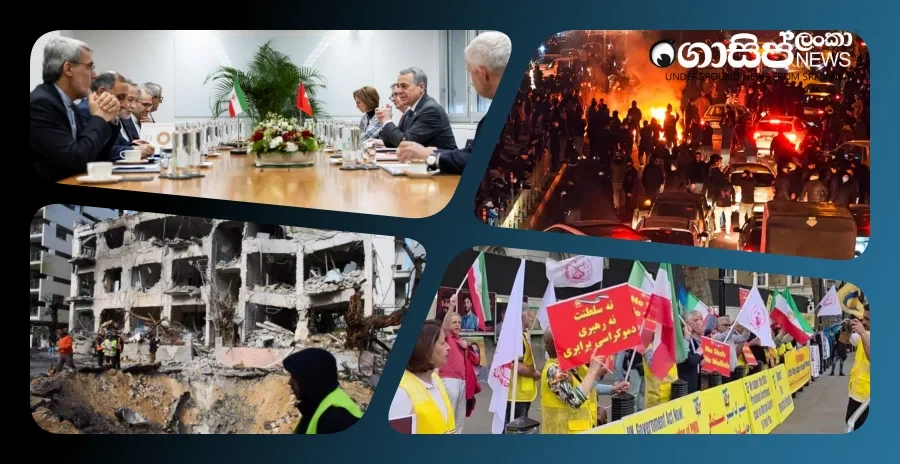
Critical discussions are currently progressing rapidly to further extend the ongoing ceasefire between the United States and Iran, and to establish a peace agreement (MoU) between the two countries. As reported by May 25, 2026, these discussions, primarily facilitated by Pakistan, also have the support of regional countries such as Saudi Arabia, the United Arab Emirates, Qatar, Egypt, Jordan, and Bahrain.
US President Donald Trump has stated via his 'Truth Social' account and in various interviews that this agreement is largely finalized, and that reopening the Strait of Hormuz is a key component of it. However, he has advised his representatives not to rush the negotiations, and has emphasized that Iran's previously submitted proposals are entirely unacceptable.The backdrop for these discussions is the massive military operation 'Operation Epic Fury' launched jointly by the United States and Israel against Iran on February 28, 2026. This included over 900 attacks targeting Iran's missile sites, air defense systems, military infrastructure, and leadership, during which Iranian Supreme Leader Ali Khamenei was also reportedly killed. In response, Iran launched drone and missile attacks against Israel, American bases, and Gulf regional countries. These conflicts caused severe damage to infrastructure in Iran, Lebanon, and Israel, resulting in thousands of deaths and displacement of a large number of people. Subsequently, with Chinese influence and Pakistan's mediation, a two-week conditional ceasefire was declared on April 7 and 8, which was later further extended during the ongoing discussions.
Despite the ceasefire, the slowing pace of negotiations led the United States to impose severe restrictions on maritime traffic through Iranian ports and the Strait of Hormuz. The blocking of this critical sea lane, through which about 20% of the world's oil supply is transported, caused global oil prices to exceed $110 per barrel, severely impacting the global economy. Vice President J.D. Vance and a delegation of representatives participated in the discussions held in Pakistan, marking the highest level of American involvement in decades. Iran had put forward the withdrawal of American troops from the region and the easing of sanctions as preconditions for the talks.
A key component of the proposed new peace agreement is the control of Iran's nuclear program. Halting uranium enrichment to near weapons-grade levels and destroying existing stockpiles or transferring them to another country has been a major demand from the United States. A senior official in the Trump administration, speaking to CBS News, stated that Iran has fundamentally agreed to the policy of disposing of enriched uranium. Ending all hostilities, including conflicts in Lebanon, gradually reopening the Strait of Hormuz and removing American blockades, allowing Iran to export oil, and opening a window for nuclear talks within 30 to 60 days are considered the basic structure of this agreement. However, a complete lifting of sanctions is not expected at the outset.
US Secretary of State Marco Rubio has also expressed his satisfaction with this progress, and regional leaders are pressuring for the acceptance of this framework agreement. As a result, the global market is showing positive growth, with oil prices falling and stock markets rising. However, Iran states that a final agreement has not yet been reached, and they expect a Persian-style peace subject to their conditions. Specifically, they are trying to postpone nuclear concessions. Meanwhile, Israel and Prime Minister Benjamin Netanyahu are closely monitoring these agreements due to concerns about the incomplete destruction of Iran's nuclear program. Furthermore, disagreements over the wording of the final agreement, threats from hardliners in the Iranian Revolutionary Guard Corps (IRGC), and ongoing ceasefire violations in Lebanon continue to keep this peace process in a precarious state.