![Gossip Lanka News [English]](https://blogger.googleusercontent.com/img/a/AVvXsEhYm2aFFq-bIW1nWX-RrqnPFoIsVos6_VCVz8BpLt0QJi55GNXHXC2fugeRvL0qUStEuCfs7Sfu6ZiSlhrkldxfGuE_wzy5gitY6rMZ2KSi8VBbGvkgXLks37RwZV-4-HKbWiNLRxB8C_r1e4z3mpxFTMPDJPEADoG8E-bZteWFipeD5KNGbjvCfqEfKw=s300 "Gossip Lanka News [English]")
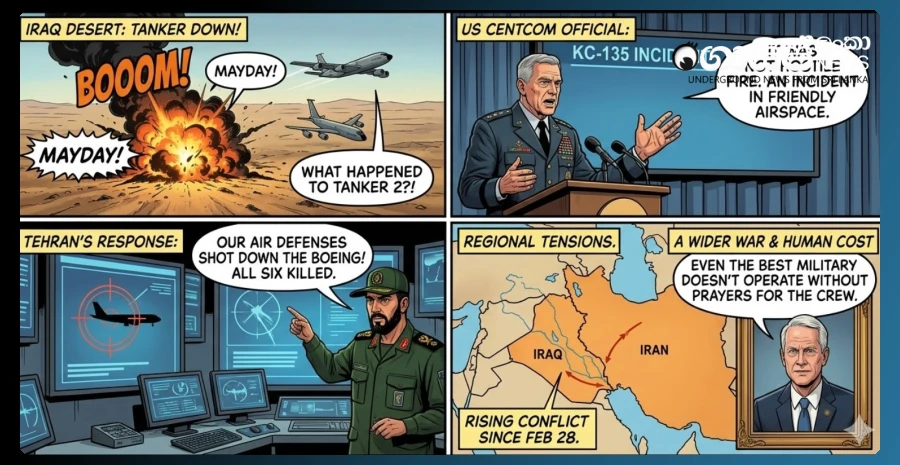
The US Central Command has confirmed that a US Air Force KC-135 Stratotanker refueling aircraft crashed in western Iraq on Thursday, coinciding with 'Operation Epic Fury' against Iran.
The US military emphasizes that this air accident was not caused by an enemy attack or friendly fire, and that it occurred within friendly airspace. Two aircraft were involved in this operation; one crashed, while the other KC-135 aircraft landed safely. Although the US has not yet revealed specific information regarding the crew of the crashed aircraft, it is believed that at least five individuals were on board, and rescue operations are currently underway.
However, contrary to American statements, Iranian state media and the Iran-backed armed group 'Islamic Resistance in Iraq' have claimed responsibility for the attack. They state that the aircraft was shot down by a missile strike launched to protect their country's sovereignty, and that all six crew members on board at the time were killed. American authorities, however, strongly reject this claim of an enemy attack, asserting it was merely an accident.
The crashed KC-135 aircraft is one of the oldest and most crucial aircraft models in the US Air Force, used for aerial refueling of other planes for long-range operations. Manufactured by Boeing in the 1950s and 60s, these aircraft typically operate with a crew of three to four people, including a pilot, co-pilot, and a boom operator.
This is considered the fourth aircraft lost by the US in the state of war that began on February 28 between Iran and the joint US-Israeli forces. Last week, three F-15E Strike Eagle fighter jets were destroyed over Kuwait due to friendly fire, but all six crew members survived unharmed. So far, seven US military personnel have lost their lives in this entire conflict, and the US has attacked over 6,000 targets within Iran.
Commenting on the incident, Democratic Congressman Jim Himes stated that even the world's best military cannot completely prevent such accidents in a wartime situation, and that it is an unavoidable cost of conflict.

