
The Anuradhapura Sacred City is not merely a historical zone with ruins. It is a living spiritual city that heals the hearts of thousands of people burdened by mental stress.
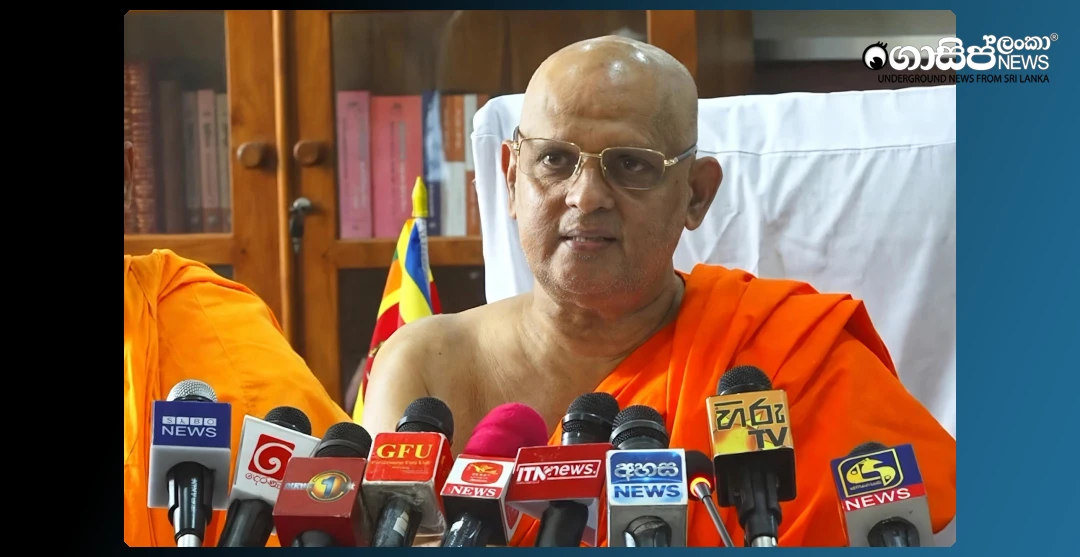
However, behind the management of facilities for these millions of devotees and the conservation of this World Heritage site for the future lies a massive, unseen operation.Recently, with the gazette notification issued regarding the Anuradhapura Sacred City Development Plan, various controversies and doubts arose within society. Both authorities and the Maha Sangha now acknowledge that the primary reason for this was a lack of proper communication. Amidst this backdrop, Venerable Eethalwetunuwewe Gnanathilaka Thero, the Acting Atamasthanadhipathi and Chief Incumbent of Ruwanweli Maha Seya, made a special request to the public during a special press conference held this morning (16) at the Ministry of Buddha Sasana. He requested that they not sabotage the proposed Anuradhapura Sacred City Development Plan, but instead provide the necessary support for its successful implementation.
His Eminence stated that following the public discourse sparked by the gazette notification, the President visited Anuradhapura for a field inspection, where he met with the monks of the Atamasthana and sought their views. As a result, in accordance with a proposal made by the Maha Sangha to appoint an expert council, a 32-member Presidential Advisory Council has been appointed, comprising professors, scientists, philosophers, and ministry officials. Scholars representing the Universities of Kelaniya, Rajarata, Peradeniya, and Jayawardenapura are also included.
The main responsibility of this council is to provide policy guidance, determine priorities, and monitor the progress of legal decisions for the conservation, management, and development programs implemented within the Sacred City. Venerable Gnanathilaka Thero expressed his appreciation that this council, through the intervention of Mr. B.K. Prabath Chandrakirthi, convened today (16) and commenced discussions within a very short period. Upon the President's instructions, there is also the possibility of including more qualified scholars in this council in the future if necessary.
Misconceptions Spread in Society and the Actual Situation
Venerable Gnanathilaka Thero provided clarifications on several issues that were widely discussed in society. He recalled that the Chief Incumbent of Abhayagiri also personally expressed regret over the inability to inform the public about certain plans from the outset.
The first issue was the matter of the 'fence' said to be built around the Sacred City. There had been a request from the late Chief Incumbent to complete the remaining part of a fence constructed a decade and a half ago. Its primary purpose was to prevent vehicles from parking on archaeological monuments, unauthorized constructions, and damage caused by animals such as cattle or goats. However, His Eminence stated that there is no intention to erect a fence covering the entire Atamasthana, and that the fences related to Isurumuniya, Vessagiriya, and Ranmasu Uyana were merely concepts. He confirmed that the idea of erecting those fences has now been completely abandoned.
The second most serious controversy was the rumor that people living within the Sacred City would be forcibly evicted. Venerable Gnanathilaka Thero emphasized that there is no such concept or plan. However, 100 acres of land in the Lolugaswewa area have already been allocated for qualified individuals who wish to relocate voluntarily, and efforts are underway to acquire another 100 acres. He explained that a fully-fledged 'sub-city' with commercial value, including a national school, a banking system, transportation facilities, and legal deeds, is being created there.
The Mystery of 28 Square Kilometers and Unseen Management
His Eminence also answered the significant public concern about why a large area of 28 square kilometers has been allocated for this plan. He stated that it is merely a technical requirement for facility management.
When one hundred thousand people visit the Sacred City, approximately 25,000 cars, 10,000 vans, and 5,000 buses enter the city. During the Poson season, nearly 1.3 million devotees arrive, and about 300 alms-giving stalls (dansal) must be managed by the Sacred City Committee, the Mayor, and the District Secretary.
“There is a large unseen aspect to this,” said Venerable Gnanathilaka Thero, providing several practical examples. To remove flowers from the Sacred City on weekends alone, 10 to 12 tractors are needed. Annually, 200 tractor-loads of sand are required for the courtyard of Ruwanweliseya. Waste must be removed weekly by gully bowsers. He pointed out that there are instances where even drinking water becomes scarce due to massive alms-giving events (pinkam) that arrive without prior notice. A vast land area is absolutely necessary to manage this enormous crowd and their vehicles.
Spiritual Healing and Future Responsibility
This sacred site, protected by 104 kings in the past, is today preserved through the dedication of both Buddhist and non-Buddhist people. This land, where the Jaya Sri Maha Bodhi, a measure (drona) of relics, the Tooth Relic, the Bowl Relic, the Belt Relic, and the Jayakonthaya (Victory Spear) are enshrined, is a global spiritual center.
People suffering from mental problems such as depression, phobia, hysteria, and schizophrenia in contemporary society come to this holy site seeking solace. Venerable Gnanathilaka Thero noted that many who arrive weeping with economic and social problems leave with smiling faces after worshipping, dressed in white.
His Eminence stated that they have great expectations from this, the first and largest expert council appointed for such a topic in Sri Lankan history. He emphasized that the responsibility of protecting this holy site for the future of the entire population of 21.7 million, as well as for the 4.3 million children, rests with this council and society as a whole. He urged all parties to support this national endeavor without creating unnecessary fear.