
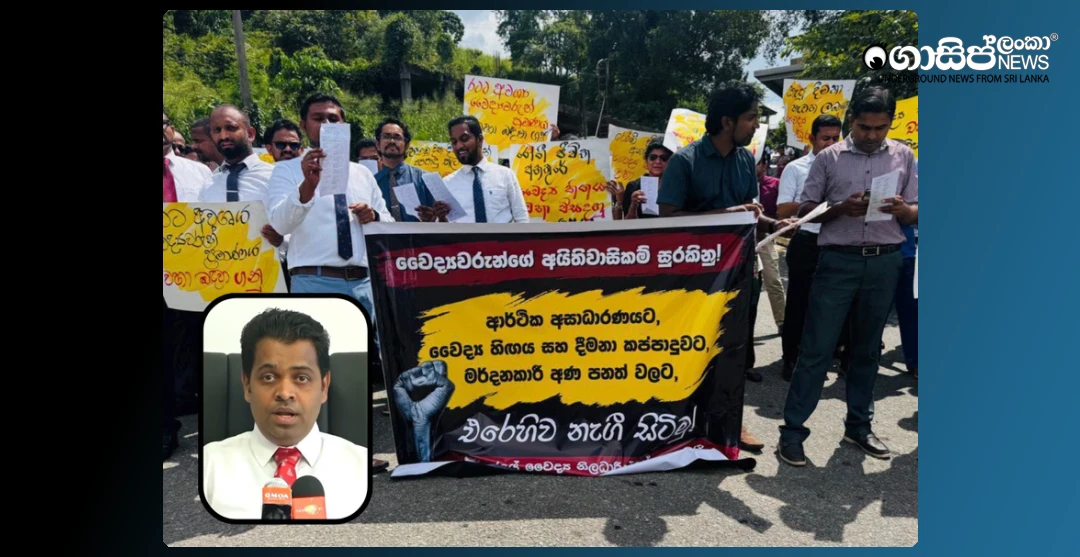
Sri Lanka, which has health indicators similar to those of developed countries, is paying the lowest salaries in the region to the pioneers of this achievement, thereby subjecting them to severe economic and professional pressure, states the Government Medical Officers' Association (GMOA). In response, the GMOA has decided to hold a massive protest in front of the Colombo National Hospital on Tuesday, November 10, at 12:00 noon.
Dr. Lasitha Dammika, the spokesperson for the association, confirmed that this decision was made because the government has not provided any constructive solutions even after the series of protests launched by doctors at major hospitals across all districts nationwide on the past Wednesday, Thursday, and Friday.
As Dr. Lasitha Dammika points out, although the health indicators in regional countries like India, Bangladesh, Thailand, and Malaysia are not as high as in Sri Lanka, these countries pay their doctors two to three times the salary paid in Sri Lanka. He emphasized that despite Sri Lankan state leaders and ministers proudly speaking about the success of the country's health system at international conferences, the doctors who contribute to it receive the lowest salaries in the region.
With the 2022 economic crisis, the tax-exempt vehicle permits provided for doctors' official transport facilities were abolished, and a high percentage of tax began to be levied on allowances given to cover official expenses. Furthermore, one-third of the allowances for additional duties and holidays in the health service were suspended during the 2025 public service salary revision, based on a promise made by the President in Parliament that it would be repaid once the economic situation improved. The doctor alleges that despite the government and the President now claiming that the country's economy has stabilized, neither the promised allowances nor a fair salary revision has been provided yet.
A massive administrative crisis, second only to salary issues, has also emerged. There has been no approved staff revision in the health sector for eleven years, specifically since 2015. In a context where the health system has expanded enormously through projects adding new hospitals, units, and a thousand government health centers, and thousands of healthcare workers, including doctors, have left the country, the system is being maintained without collapse solely due to the immense workload borne by the remaining doctors.
Dr. Dammika states that the Ministry of Health has failed to resolve this crisis based on scientific data and has even ignored requests made through the Right to Information Act. He also expressed suspicion that instead of providing solutions, there is an attempt to create conflict between the public and healthcare workers through social media propaganda mechanisms.
Three months ago, a formal proposal targeting the 2027 budget, including methods to retain doctors in the country, eliminate economic injustice, and earn foreign exchange for the country through the health sector by utilizing Sri Lanka's location and service economy, was submitted to the President, the Prime Minister, and the Minister of Health. However, the government has not yet been flexible enough to even grant a discussion on the matter.
At the protest on November 10 against these stringent policies, economic demands such as the reinstatement of the suspended one-third allowance, updating the DAT allowance, removal of oppressive taxes levied on official expenses, and the provision of a proper salary will be pressed upon the government. Concurrently, the Government Medical Officers' Association emphasizes that reducing the workload of doctors through a swift scientific staff revision, and ensuring a continuous supply of quality medicines and infrastructure for the public, are primary objectives of this struggle. Dr. Lasitha Dammika further stated that they expect a positive response from the government regarding these matters.