
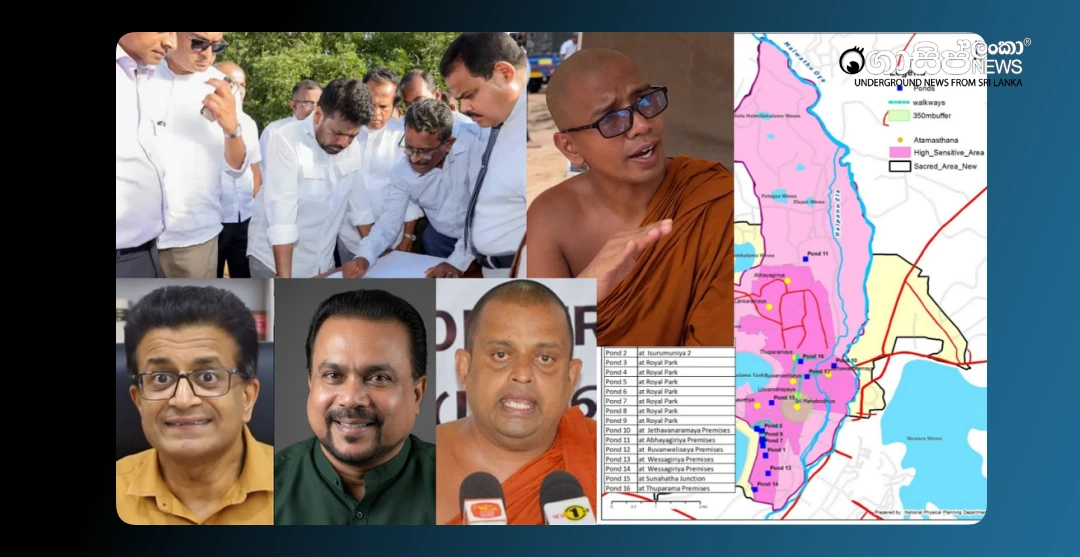
The Anuradhapura Development Plan is a hotly debated topic these days. On one side, a frightening picture is being painted for society, suggesting that historical stupas like Ruwanwelisaya will sink, and spas and liquor stores will be built within the sacred city.
However, reading between the lines of these protests reveals that a completely different tragedy of land grabbing and unauthorized settlers is hidden behind this struggle.This controversial situation escalated after the press conference held by Mr. Udaya Gammanpila, leader of the Pivithuru Hela Urumaya, in Colombo on October 26th. He stated that underground constructions and tunnels under the proposed Anuradhapura Sacred Area Development Plan could impact the foundations of major stupas, including Ruwanwelisaya, posing a risk of their destruction.
Furthermore, he alleged that by not specifically mentioning 'Buddhist shrines' or 'ancient shrines,' the plan would allow for the construction of other religious sites and kovils, as well as the establishment of liquor stores and spas within the proposed public service zones. The essence of his statement was that the historical and cultural identity of Anuradhapura, the heart of Theravada Buddhism, is at risk.
However, the government's National Physical Planning Department (NPPD) issued a statement confirming that these claims were merely a misinterpretation of the gazette notification. They clarified that the plan does not intend to construct any new religious sites or obstruct devotees. Meanwhile, Mr. Upali Ratnayake, an Anuradhapura District activist of the National Intellectuals' Organization and former national cycling coach, and Mr. Deepal Tilakaratne, a retired accountant and active member of the Rajarata University Voice Organization, have filed a complaint against Mr. Gammanpila with the Criminal Investigation Department.
They are thus requesting an impartial investigation and legal action, stating that the relevant statements could cause religious unrest among Buddhists and disrupt public peace, especially given the controversial backdrop of a Supreme Court ruling involving a Buddhist monk.
Beyond this political and legal conflict, the true situation on the ground becomes clear. A primary objective of the controversial development plan is to systematically excavate the ancient city, or the area of Padhanagharas, royal palaces, and the inner city of Western Anuradhapura, using modern technology to unearth its past glory. The special feature is that this main excavation zone is located about two to three kilometers away from the sacred city. This area, centered around Sanghamitta Mawatha and Anula Mawatha, is not typically frequented by devotees and contains extremely important archaeological ruins dating back beyond 300 BC. The ruins of the Kali Kovil and other kovils are located near Nuwara Wewa, which is unrelated to this area.
The true underlying motive of the organized protests emerges when observing the irregularities that have occurred around this historical land. Numerous unauthorized settlers have built houses on the ancient city wall and within this zone, with some even obtaining various permits through the intervention of politicians during past government regimes. It is alleged that these protests were orchestrated with the aim of protecting their unauthorized homes and lands, as these individuals would be forced to vacate the relevant areas if new excavation and conservation plans are implemented. Groups that allow artifacts to be covered by jungle and then seize those lands are involved in this, and the emergence of statements from monks like Balangoda Kassapa in parallel with this appears to be one connection.
Two years ago, during the exploration of this site, only two Padhanagharas were somewhat conserved, while the remaining ruins were covered by jungle. The explorations conducted there debunked existing theories about the Western monastic complex, identifying them as royal palace ruins dating back to 600 BC, which was then publicized. Subsequently, the Department of Archaeology cleared the jungle from the land where the building foundations were located.
Preventing this true history from emerging is another main objective of the protests. Criticisms are leveled against certain groups, who have become pawns of politicians and racketeers, for misleading ordinary Buddhists and spreading racism and religious extremism. This organized effort to obstruct Anuradhapura's journey to becoming a World Heritage site and to oppose archaeological explorations and conservation work implies yet another attempt to continuously plunder one of the most important sites in Sri Lankan history. This is why it has become essential to provide support for transparent archaeological explorations, without discrimination based on race or religion.
See the PDF related to the new Sacred Area Development Plan below
