
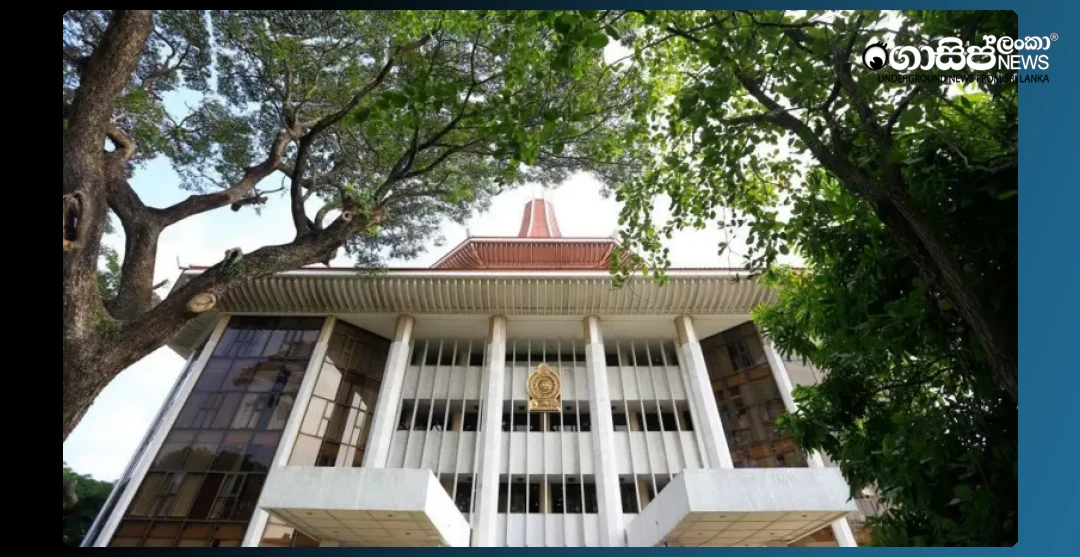
Serious warnings are emerging before the Supreme Court that the proposed 'Prevention of Organized Crimes Bill' poses a significant risk of transferring the powers of the country's judicial system to the executive and the police, thereby reducing the magistrate to merely a 'rubber stamp'. The Supreme Court is currently hearing 26 petitions filed seeking a ruling that this bill, which defines even ordinary offenses like intellectual property infringements as serious crimes, is unconstitutional.
The hearing of these petitions continued for the second day on November 09 before the three-judge bench comprising Chief Justice Preethi Padman Sooriyasena, Achala Wengappuli, and Sampath Abeykoon. The Attorney General, appearing for the government, informed the court that the government is prepared to amend the relevant bill at the parliamentary committee stage. A document containing the proposed amendments has also been submitted to the court.
However, lawyers for the petitioners point out that this draft bill violates even the fundamental basis of United Nations conventions. The United Nations and human rights organizations have already warned against making court reporting a crime without prior authorization and allowing individuals to be designated as members of criminal gangs based on their appearance, language used, or associations.
President's Counsel Romesh de Silva, appearing for petitioner Malinda Seneviratne, emphasized before the court that the way 'serious crimes' are defined in the bill is extremely dangerous.
He pointed out, 'It includes all offenses punishable by more than four years imprisonment under the Penal Code. Even offenses under the Intellectual Property Act, Trademarks, Excise, and Fauna and Flora Protection Ordinance are defined as serious crimes here.' The President's Counsel stated that by considering an intellectual property offense, which typically carries a six-month prison sentence or a fine of five hundred thousand rupees, as well as operating unlicensed gambling businesses, as organized crimes, Sri Lanka would become a laughing stock before the world. Furthermore, being aware of such an offense and failing to report it to the police has also been made an imprisonable offense.
The strongest accusation against the draft bill is that it curtails judicial power and grants unlimited authority to the executive and the police. Under the proposed bill, the Inspector General of Police or a Deputy Inspector General of Police can request the Secretary of Defence to detain a suspect. The Secretary of Defence then has the power to issue detention orders ranging from two months to one year.
Attorney Suren Fernando, commenting on this, pointed out that even in the absence of such a detention order, when an arrested suspect is presented to the court, the magistrate is left with no alternative but to remand him. 'The magistrate is not given the opportunity to apply judicial mind and make decisions. The magistrate has been reduced to merely a rubber stamp,' he stated. He further emphasized that allowing a suspect to be held in police custody for 72 hours without judicial oversight, and transferring the power to grant bail from the Magistrate's Court to the High Court, are serious problematic situations.
The issue of 'participation' mentioned in Section 10 of this bill also came under severe criticism. Attorney Suren Fernando provided an interesting example: 'Imagine a criminal group organizing a shramadana (community service) or a dansala (alms-giving). No crime is committed there. But under this bill, that act too is an offense. If such a thing is prosecuted, the court will have to convict them.'
President's Counsel Saliya Pieris, appearing for the Bar Association of Sri Lanka, drew the court's attention to the fatal blow this bill deals to media freedom and court reporting. According to Sections 14 and 14(3) of the bill, revealing the identity of a victim of a serious crime, as well as printing or publicizing any matter of a case without court permission, is a punishable offense. He stated, 'Due to this provision, even court news reporting activities will become impossible. There are no provisions for monitoring investigations. Judicial oversight has been completely removed.'
President's Counsel Eraj de Silva argued that this draft bill was prepared by 'collecting bits and pieces from here and there'.
Retired Air Force officer Shantha Jayathilake, appearing for his petition, recalled a past political statement. He quoted a statement made by current Foreign Minister Wijitha Herath during the debate on the Prevention of Terrorism Act in 2022, regarding the disadvantages of vesting full power in a minister. 'Mr. Wijitha Herath questioned back then what would happen if such power fell into the hands of a person suffering from a mental disorder. Today, a similar situation is seen in this draft bill.'
Lawyers point out that to confirm the constitutionality of this draft bill, which seriously violates the fundamental rights of the people and the independence of the judiciary, it must necessarily be subjected to a referendum. This legal debate, which unfolded before the Supreme Court for two days, has left a critical question mark regarding civil liberties and the extent to which judicial power can be usurped by the executive.