
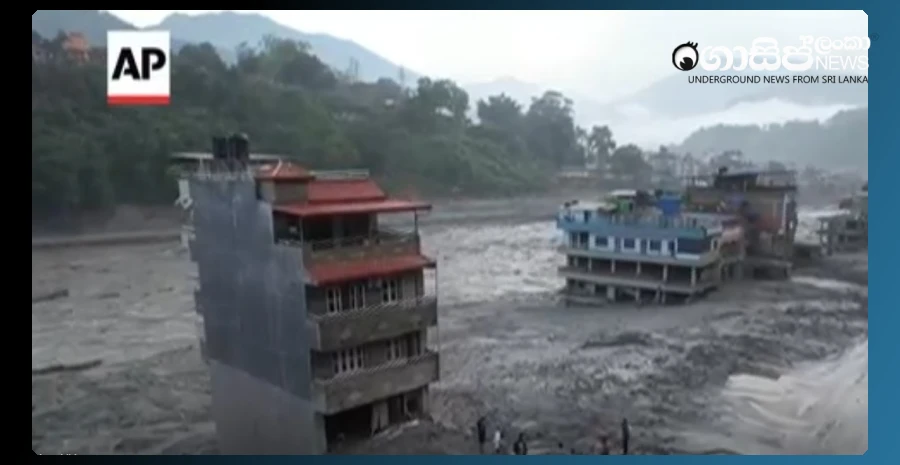
The hazardous situation has further escalated due to the severe floods, mud, and snow flows along the Bhote Koshi and Trishuli river systems, caused by a massive avalanche and rockfall disaster near the Langtang Lirung mountain range on the Nepal-Tibet border on August 26, 2026. On Sunday, August 30, as the water level in the Bhote Koshi River rose again, and China notified Nepal about the increased water flow upstream, authorities re-issued emergency warnings via mobile phone messages.
Although the water in the barrier lake formed after the initial disaster has largely receded, the crater with a water capacity of 1.4 million cubic meters, located 5.6 kilometers upstream, still requires strict monitoring. For this reason, residents of Rasuwa, Nuwakot, Dhading, and Chitwan have been advised to avoid going to the river banks.During this disaster, which began around 9:00 AM on Wednesday, August 26, a large section of the Langtang Lirung glacier and the underlying rock layer near the Nepal-Tibet border collapsed into the lower valley, falling between 1,200 and 2,000 meters. This collapse, recorded as seismic energy with a magnitude of 5.2, temporarily blocked rivers, and the subsequent debris-filled flood flowed towards the plains of Rasuwa, Nuwakot, Dhading, and Chitwan. On the Chinese side, this severely damaged Gyirong County and the Gyirong Port of Entry.
Scientists indicate that this was more of a snow and rock landslide or an avalanche collapse rather than a traditional glacial lake outburst flood. However, the new barrier lakes created by the debris later overflowed. Over the past 30 years, Himalayan glaciers have lost about one-third of their ice volume, and their melting has accelerated by 65 percent in the last decade. The thawing of permafrost layers and the loosening of glacier beds by water contribute to such collapses. While attributing this isolated event solely to climate change might be premature, this emerging trend in high-altitude regions is consistent with global warming. Nepal, contributing only about 0.1 percent of global emissions, has to face a disproportionate impact from this.
As of August 30–31, 781–788 confirmed deaths and 2,502 missing persons have been reported from Nepal, while 16 deaths and 546 missing persons have been reported from Tibet. Accordingly, the total number of deaths is close to 800, and the number of missing persons exceeds 3,000. Among the missing are hundreds of foreigners from over 30 countries, including Kailash Peak pilgrims, mountaineers, and workers. India (over 177), the United States (over 90), Britain (over 33), Australia, and Canada are prominent among them. Hundreds of employees from private hydropower projects are also missing. Bodies are being recovered from lower river sections, and due to overflowing morgues, unidentified bodies are being mass buried in the Devghat area of Chitwan after DNA samples are collected.
Over 90,000 people have been affected by this disaster, and more than 9,400 people have been rescued via air and road routes. Over 20,000 security personnel, including the Nepal Army, Police, Armed Police Force, as well as experts from China and India, have been deployed for search operations. Prime Minister Balendra Shah (Balen Shah) stated that this is a severe test for the nation and that saving every life is the state's top priority. According to the Prime Minister's Office, 394 helicopter sorties have been conducted, including operations carried out on Sunday.
Entire villages and river valleys have been submerged under layers of grey-brown mud and debris. Houses, vehicles, tractors, and paddy fields have been swept away. Kilometers of the Prithvi Highway and dozens of bridges have been destroyed. 14 hydropower projects, including Upper Trishuli, Trishuli 3A, and 3B, with a total capacity of 748 megawatts, have been damaged. The initial damage exceeds $1.3 billion, and billions more will be spent on reconstruction. Schools, health centers, and power lines were also damaged.
Rescue teams have deployed heavy machinery, helicopters, sniffer dogs, and Everest experts, with the main operation focused on rescuing over 100 workers trapped in mud-filled hydropower tunnels. Drilling operations have commenced, including the insertion of air pipes, but have been hampered by adverse weather and difficult terrain.
Heavy rains and thunderstorms are forecast for the affected mountainous regions, increasing the risk of secondary floods and landslides. China and Nepal are jointly conducting monitoring activities using satellite technology and sensors, and Chinese President Xi Jinping has also instructed close observation. The World Bank, Asian Development Bank, Australia, Switzerland, the United States, and the World Health Organization have provided aid, while India and China are offering Bailey bridges and technical assistance. Restoring the destroyed main highways and power systems will be a major challenge in the coming weeks and months.