![Gossip Lanka News [English]](https://blogger.googleusercontent.com/img/a/AVvXsEhYm2aFFq-bIW1nWX-RrqnPFoIsVos6_VCVz8BpLt0QJi55GNXHXC2fugeRvL0qUStEuCfs7Sfu6ZiSlhrkldxfGuE_wzy5gitY6rMZ2KSi8VBbGvkgXLks37RwZV-4-HKbWiNLRxB8C_r1e4z3mpxFTMPDJPEADoG8E-bZteWFipeD5KNGbjvCfqEfKw=s300 "Gossip Lanka News [English]")
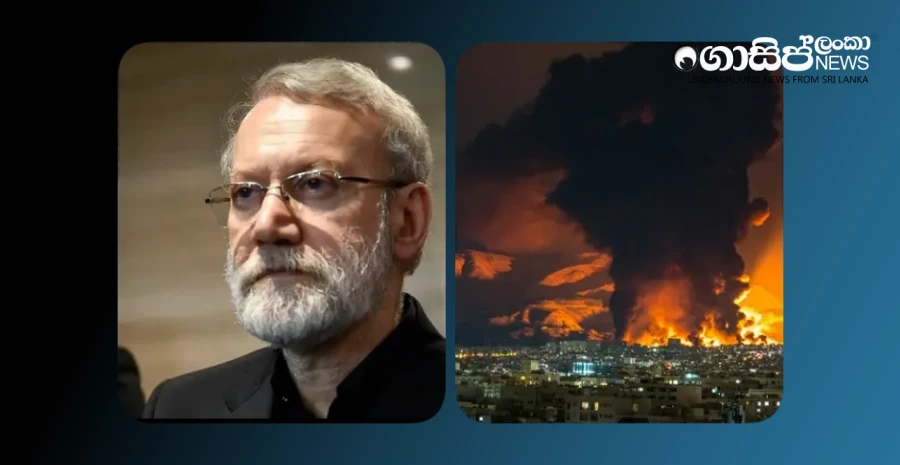
In a significant escalation of the massive war currently raging between the United States, Israel, and Iran, Ali Larijani, Secretary of Iran's Supreme National Security Council (SNSC) and one of the country's most powerful leaders, has been killed in an Israeli airstrike. This was officially confirmed by Iran on March 17 and 18, 2026, hours after Israel stated that he was assassinated in a 'precise' targeted nighttime strike carried out by the Israel Defense Forces (IDF).
Larijani, who was sixty-seven years old, served as Iran's acting leader after the assassination of Iran's Supreme Leader Ayatollah Ali Khamenei on February 28, 2026, the first day of this conflict. As the head of the Supreme National Security Council, he guided Iran's national security, military strategies, and key decision-making processes amidst intense airstrikes and regional crises. Israeli Defense Minister Israel Katz later confirmed that he was completely 'eliminated' in this targeted attack near Tehran.
Concurrently with this attack, the Israeli army announced that Gholamreza Soleimani, head of the Basij paramilitary force used for internal suppression, was also killed. Meanwhile, Iranian state media networks Tasnim, Fars, and Mehr confirmed Larijani's death, referring to him as a 'martyr.' According to reports, several security officials, including Larijani's son and Deputy Head of Security Morteza Larijani, and his Chief of Staff Ali Reza Bayat, also died in the attack. Various sources report that the attack targeted a safe house or his daughter's residence in the Pardis area near Tehran.
This assassination, occurring approximately three weeks after the start of intense operations dubbed "Operation Epic Fury," is considered the most severe blow to the Iranian leadership since Khamenei's death. Larijani, a close associate of Khamenei, was a proponent of pragmatic approaches, such as nuclear agreements with Western countries, and a powerful figure who coordinated Iran's proxy networks. Critics point out that with his loss, Iran has lost a key negotiator who could have mediated future ceasefires or peace talks.
With this situation, the war tensions in the region continue to escalate, with reports of blockades in the Strait of Hormuz and Iranian attacks on Israel and the Gulf region. Meanwhile, US President Donald Trump has strongly criticized NATO allies for not supporting the security of the Strait of Hormuz. While the loss of senior leaders like Larijani and Soleimani has severely impacted Iran's military operational structure, some parties warn that the elimination of moderate figures who were open to negotiations through these assassinations could negatively affect Israel and the United States. Iranian media is portraying these deaths as an opportunity to strengthen their resolve.